

There are two ways to spend a holiday on Turkey’s southern coast. One is to check into a hotel and walk down to the same beach every day. The other is to step aboard a boat and wake up in a different bay every morning. The second is called a blue cruise, and it has been part of life on this coast for around sixty years.
In this guide we explain what a blue cruise is, where it came from, which routes are most popular, which boats you can choose and what drives the budget. If it is your first time, start here; if you have been before, the route section may still be useful.
What is a blue cruise?
A blue cruise is a sea holiday on the Aegean and Mediterranean coast of Turkey, moving from bay to bay by boat. You don’t stay in a hotel — the boat is both your transport and your bedroom. A typical day goes like this: a short passage in the morning, dropping anchor in a bay around midday, swimming and relaxing in the afternoon, dinner on deck in the evening and a night at anchor in that bay. The next morning, the same rhythm somewhere new.
The route is shaped not by beaches but by bays and islands. A one-week cruise usually visits 5–7 different spots. The captain adjusts the order to the weather and how busy the bays are, and that flexibility is part of the experience.
Blue cruise or blue voyage?
The two terms are often used interchangeably, but there is a nuance:
- A blue cruise often describes day trips or short boat tours of 2–3 days.
- A blue voyage describes longer trips of four days, a week or ten days, sleeping on board.
In practice, someone who says “we’re going on a blue cruise this summer” usually means a week-long blue voyage. In this guide we cover both together.
A short history
The term is traced back to the writer Cevat Şakir Kabaağaçlı, known as the “Fisherman of Halicarnassus”, who was exiled to Bodrum in the 1920s. Kabaağaçlı and the circle of writers and artists around him began chartering the wooden boats used by sponge divers — the gulets — and travelling along the coast. By the 1960s these trips had become known as the “blue voyage”, and over time they grew into a form of tourism of their own.
Today’s trips are a long way from the sponge divers’ boats: air-conditioned cabins, generators, water toys and professional crews are now standard. But the core idea is the same — the route itself is the holiday.
What does a day look like?
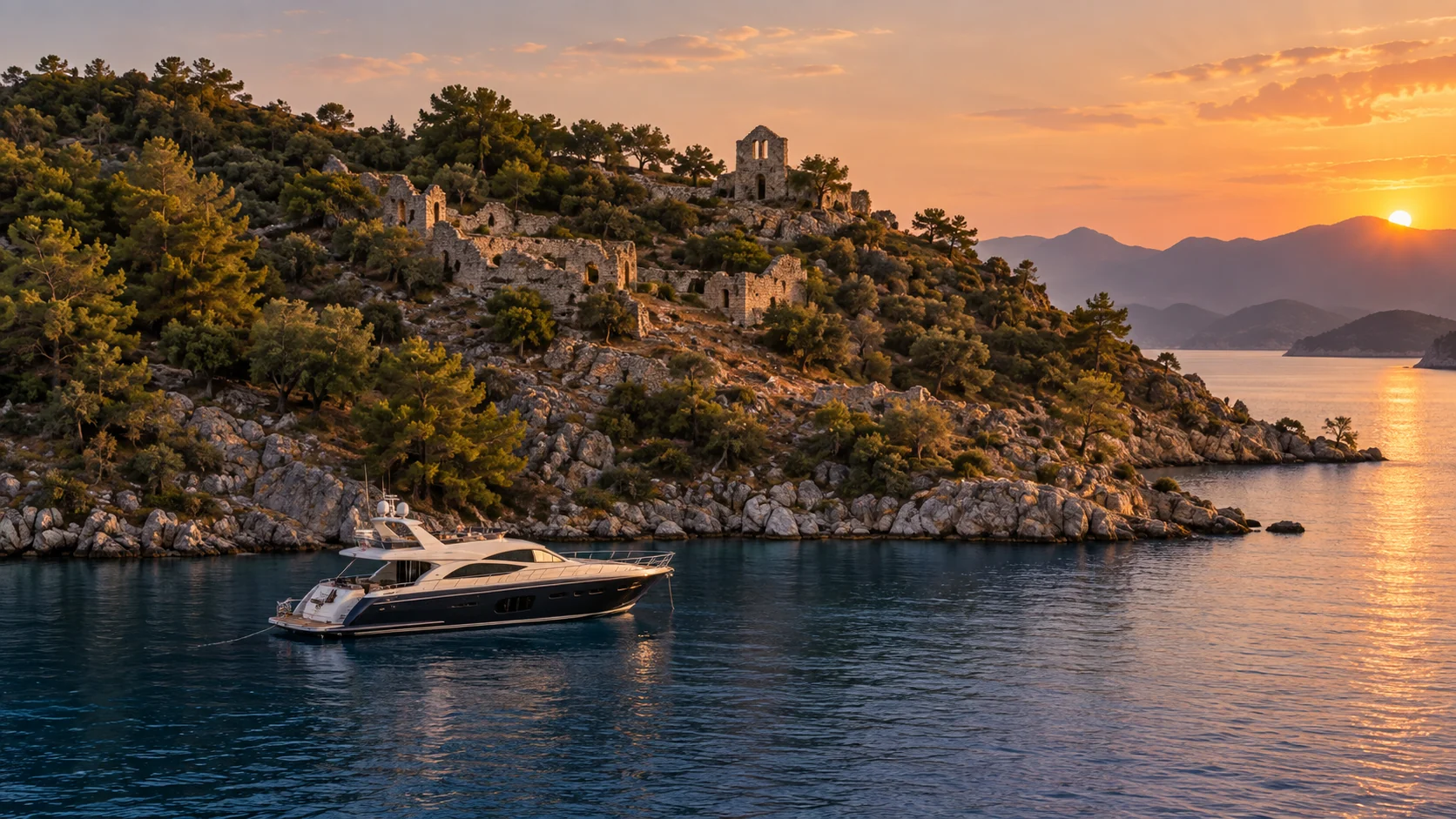
The thing first-timers wonder about most is the rhythm. A typical day flows like this:
- 08:00–09:00 Breakfast is laid out on deck. The cook prepares fresh bread, cheese, olives, eggs and seasonal fruit.
- 09:30–12:00 A short passage. The captain heads for the next bay; meanwhile there is time for a book, the sun or a chat at the helm.
- 12:00–16:00 Anchoring in a bay. Lunch, then swimming, snorkelling, paddleboarding or a short walk ashore.
- 16:00–18:00 A short hop to a second bay, or staying at anchor in the same one. A sheltered spot is usually chosen for sunset.
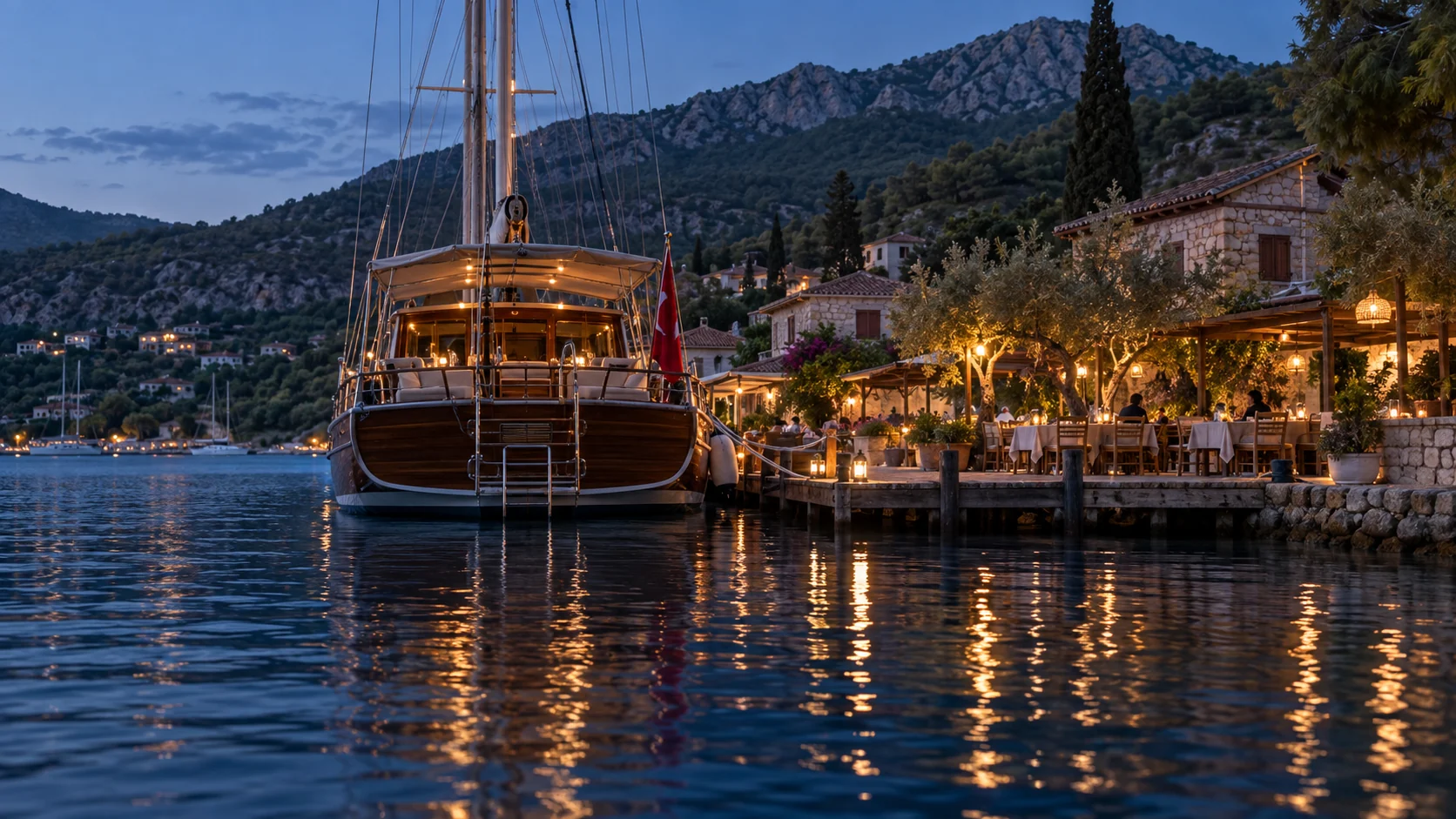
- After 19:30 Dinner. A long table, candlelight and the quiet of the bay. The night is spent at anchor there.
This rhythm is relaxed; rain, wind or simply the group’s mood can shift the programme. Flexibility isn’t a flaw — it is the essence of the experience.
The most popular routes
Gulf of Gökova (from Bodrum)
Leaving Bodrum and heading deep into the gulf, this is the classic route. English Harbour, Değirmen Bükü, the Seven Islands, Karacasöğüt and Kargı Bay are the main stops. The water is sheltered, surrounded by pine forest and relatively calm — ideal for first-timers. Because Gökova is also a marine protected area, the water is very clear and the fish life is rich.
Göcek and the Fethiye bays
The maze of islands in the Gulf of Göcek, with its short distances and sheltered bays, is the most comfortable option for families with children. The Yassıca Islands, Bedri Rahmi Bay, Tersane Island, Göbün and Sarsala stand out. We describe Göcek-based routes day by day in a separate article: our Göcek blue cruise guide.
Fethiye – Kekova
Starting in Fethiye and continuing past Ölüdeniz, Kalkan, Kaş and the sunken city of Kekova, this route combines history and nature. The underwater ruins at Kekova are the best-known highlight of this stretch.
Hisarönü and Bozburun
This area south of the Datça peninsula is a favourite with sailors thanks to its wind. Bozburun is also one of the centres of gulet building. A good choice for anyone looking for a quieter, simpler route.
The Greek islands from Bodrum
This route to Kos, Kalymnos, Leros and Patmos requires passports and a transit log. Because it combines Turkish and Greek waters in a single trip, it is increasingly popular; we recommend planning it with a crew and through a brokerage.
Which route suits whom?
| Route | Character | Best for |
|---|---|---|
| Gulf of Gökova | Sheltered, wooded, calm | First-timers, those seeking peace |
| Göcek – Fethiye | Short distances, many bays | Families with children |
| Fethiye – Kekova | History + clear water | Those who want culture and nature together |
| Hisarönü – Bozburun | Windy, simple, secluded | Sailors, those escaping the crowds |
| Greek islands crossing | Two countries, lively harbours | Experienced groups who want variety |
Which boat should you choose?
| Boat type | Advantage | Best for |
|---|---|---|
| Gulet | Large open deck, all-inclusive crew, economical per person | Large family and friend groups |
| Sailing yacht | Quiet sailing, lower cost | Groups of 2–6, keen sailors |
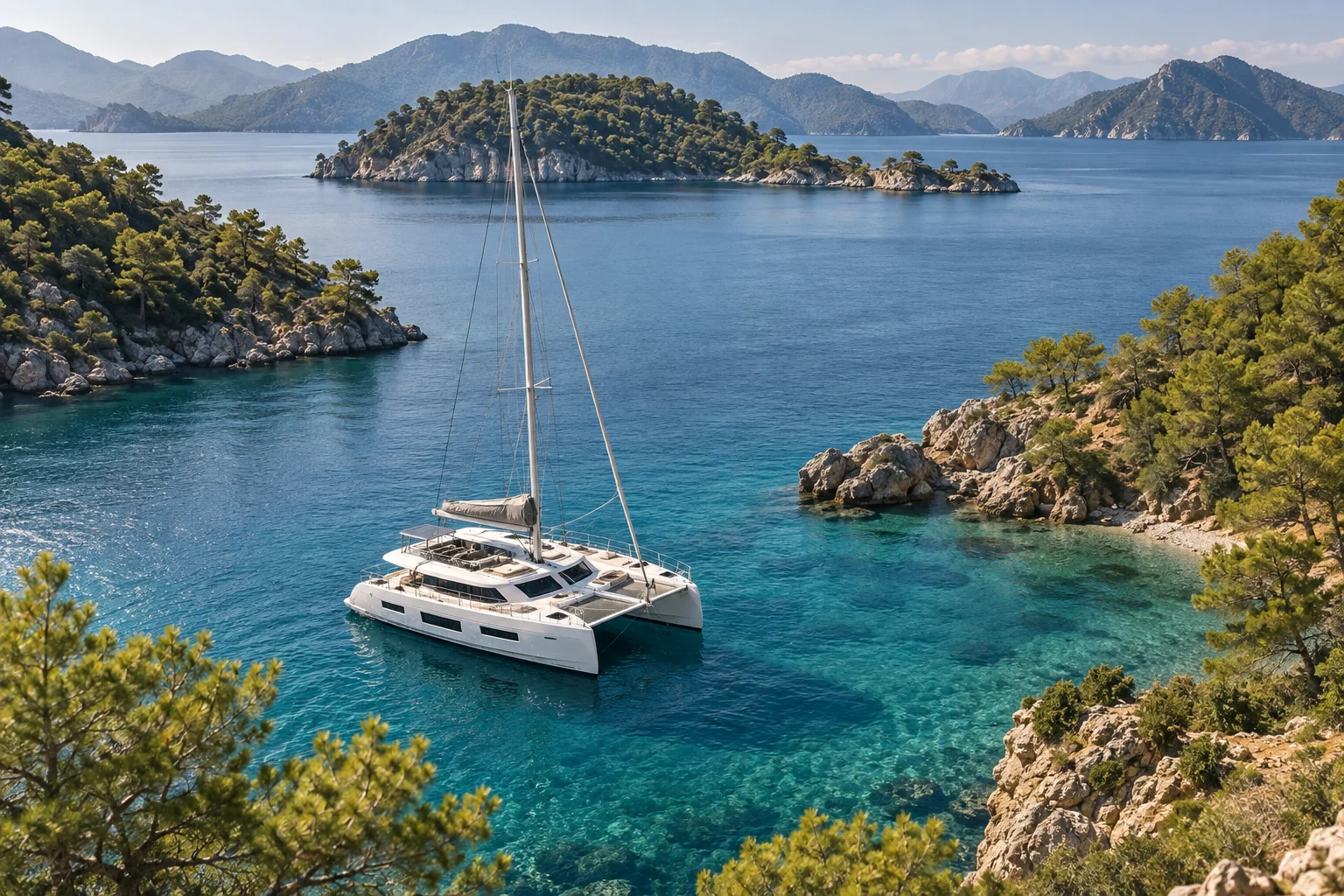
| Catamaran | Doesn’t rock at anchor, flat and spacious | Families with children, guests prone to seasickness |
| Motor yacht | Speed, long day trips | Those who want to see a lot in a short time |
We explain why catamarans are becoming so popular in our catamaran charter guide, and how motor yacht pricing works in our motor yacht charter guide.
Private charter or cabin charter?
Private charter: The boat is reserved for your group alone. You set the route and the programme is yours. For larger groups, the cost per person comes down.
Cabin charter: You book a single cabin on a boat, and the other cabins are taken by other guests. The route and dates are fixed. It is an economical way in for solo travellers and couples, but the common areas are shared.
For a couple, a cabin charter makes sense; for a group of eight, a private charter is both more comfortable and often cheaper per person.
Questions to ask before choosing a boat
Two boats in the same price range can deliver very different weeks. Before you book, ask:
- How many crew are there, and is the cook a separate person? A good cook is the most talked-about part of the week.
- How much does the boat actually sail? Many gulets mostly travel under engine; if sailing matters to you, ask directly.
- When was the last refit? A well-maintained 15-year-old boat is better than a neglected new one.
- What are the cabins like — double, bunk or convertible? Match them to your guest list.
- Does the air conditioning run all night, or is the generator switched off at certain hours? This matters in July and August.
- Does the water toy list match the listing? “Jet ski available” sometimes means “on request, at extra cost”.
When should you go?
- May–June: Sea at 20–23°C, empty bays, shoulder-season prices. Nature is at its greenest.
- July–August: Sea at 26–28°C, long days. Busy bays, peak prices and a strong afternoon meltemi wind.
- September–early October: The sea is still warm, the crowds have thinned and prices have dropped. Many captains’ favourite time of year.
If your dates are flexible, June and September are the best-balanced months.
Blue cruise prices
Prices vary widely depending on the type and size of boat, the season, the crew arrangement and the food and drink package. As a general guide:
- All-inclusive gulet packages (crew, full board, fuel allowance) can start from around €9,750 per week.
- Luxury gulet charters for 12-guest boats start from around €16,000 per week in the shoulder season; VIP boats reach €35,000 and above.
- With a cabin charter, the weekly price per person is much lower depending on the boat and dates; the exact figure is confirmed with an up-to-date quote.
A week-long gulet holiday in Turkey is usually noticeably better value than a similar programme in Greece or Croatia.
What is usually included, and what isn’t?
Included (gulet): the boat, crew, full board, anchoring in bays, bed linen and towels.
Usually extra: marina berthing fees, drinks, shore excursions, fuel surcharge (depending on the route) and the crew tip (5–15% of the charter fee).
Preparation: before you set off
- Use soft luggage. Hard suitcases can’t be stored in the cabins.
- Carry some cash. Some jetties and vendors in the bays don’t take cards.
- Protect yourself from the sun. Shade on deck is limited; a hat, long sleeves and high-factor sunscreen are a must.
- Bring your medication. There isn’t a pharmacy on the route every day.
- Think about seasickness. If you are sensitive, choose a catamaran and bring bands or tablets.
- Count the first and last days as half days. There is little cruising on embarkation and disembarkation days.
Notes for first-timers
Three things surprise people most on their first trip. First, the pace is slower than expected — that isn’t a flaw, it is how you rest. Second, some bays have no phone signal, and most guests end up missing that after a few days. Third, group dynamics matter: a group spending seven days on one boat should talk about expectations up front (early risers or night owls, active or relaxed).
A practical suggestion: if it is your first time, choose a sheltered area such as Gökova or Göcek, keep it to 4–5 days and plan a light route. If you enjoy it, a longer programme to Kekova or the Greek islands will mean much more the following year.
Frequently asked questions
How long does a blue cruise last?
The most common length is 7 days (6 nights). Short trips of 2–3 days for a weekend and long routes of 10–14 days are also possible.
I have no sailing experience — can I still go?
Yes. On crewed trips, the captain and crew take care of everything to do with the boat. Guests don’t need any sailing knowledge.
What is the food like?
On gulet charters the boat’s cook usually prepares three meals a day, included in the price. The menu can be planned in advance, and special diets and allergies are taken into account.
Is there internet and electricity?
Most boats have a generator and sockets. Mobile internet works in bays close to shore but weakens in open water. If you need a constant connection, choose a boat with satellite internet.
Can we go on a blue cruise with children?
Yes. Short-distance routes (Göcek, Gökova) and stable boats such as catamarans suit families with children. Life jackets and a supervision plan should be agreed in advance.
Can we cross to the Greek islands?
Yes, with passports, visas where required and a transit log for the boat. The process is much easier when the route is planned with a crew and through a brokerage.
Conclusion
A blue cruise is the most complete way to see the Turkish coast: a different bay every day, no hotel crowds and a programme that is yours. When the route matches your group (relaxed or active, with or without children) and the boat matches your budget, it becomes the kind of holiday most guests say they “repeat every year”.
At Aquinox Yachting we put together the route, the boat and the programme for you — from Gökova to Kekova, from Göcek to the Greek islands. Share your dates and group details, and we will review suitable options and a clear quote together.
Let us plan your route
Share your dates, group size and ideal holiday; we will shortlist the yachts and routes that fit.
Talk to a charter advisor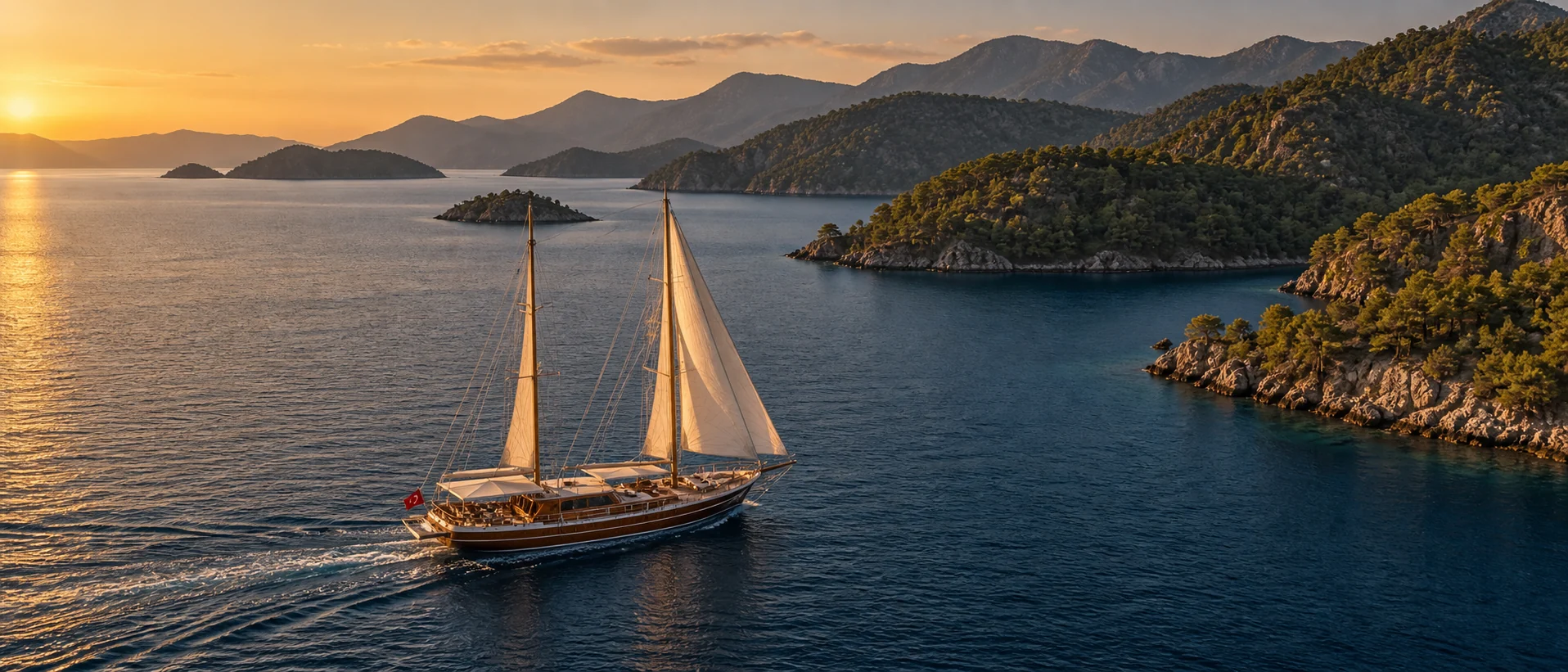



 English
 Turkish