
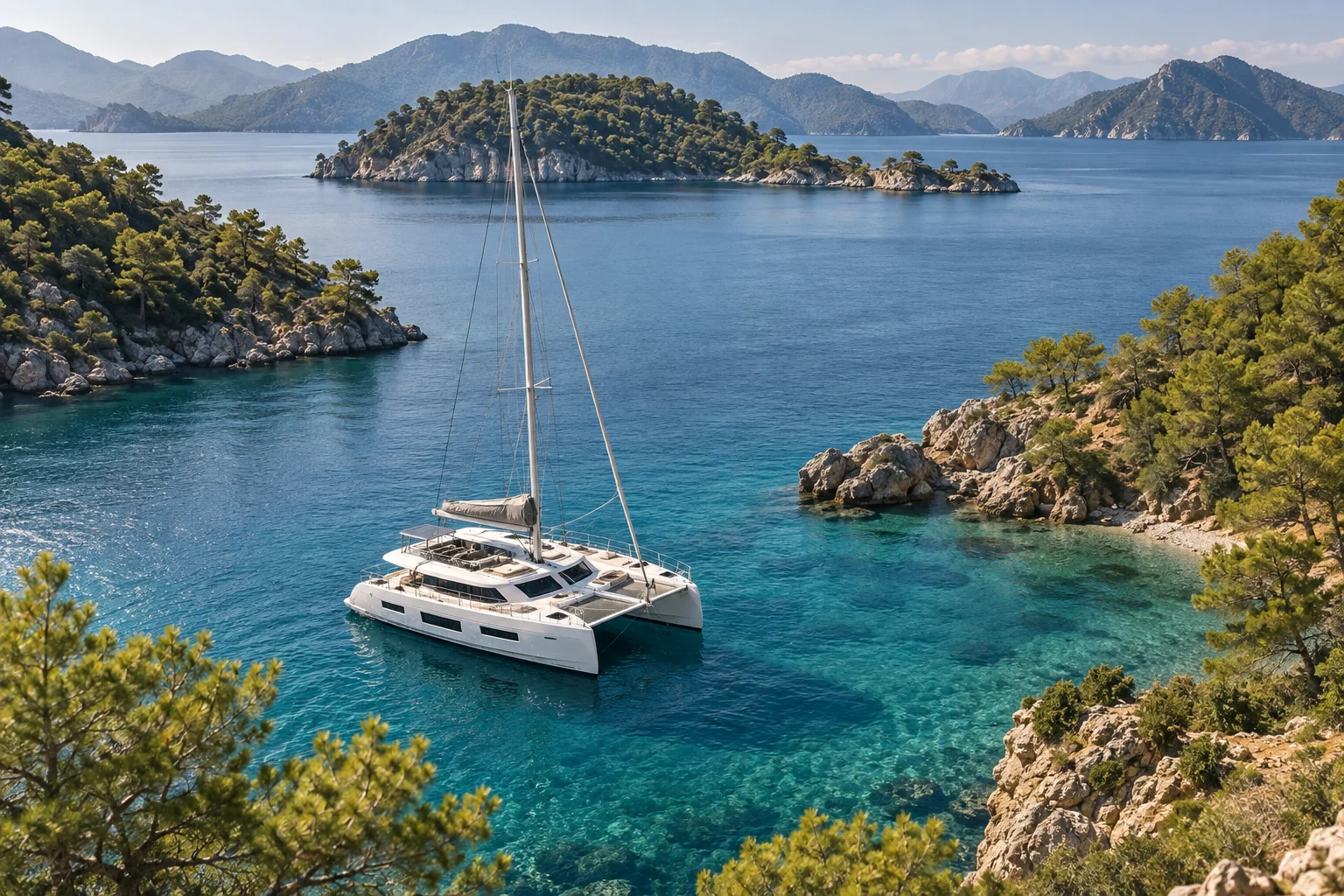
When people picture a sailing holiday on the Turkish coast, a classic gulet or a sleek motor yacht usually comes to mind first. Over the past few years, though, catamaran charter has quietly become one of the fastest-growing choices among families and groups of friends — and for good reason. In this guide we cover everything you need to know: what a catamaran actually is, how much it costs, which region suits which route, and how crewed charter differs from bareboat.
What Is a Catamaran, and Why Choose One?
Unlike a mono-hull sailboat or motor yacht, a catamaran is built on two parallel hulls. That structural difference delivers two real advantages: a much wider living area, and noticeably less rolling in the swell.
On a classic sailboat or motor yacht, the saloon is squeezed inside a single hull. On a catamaran, the saloon sits on the wide deck platform connecting the two hulls — which means significantly more room for lounging, dining, and sunbathing compared to a monohull of the same length. There’s good news for anyone prone to seasickness too: thanks to the wide base, catamarans roll far less in choppy water, which is exactly why families with children and first-time charter guests tend to gravitate toward them.
In short, if comfort is your priority and your group is on the larger side, a catamaran is almost always the right call.
Sailing Catamaran or Power Catamaran?
Catamarans are usually associated with sailing models, but power catamarans have become increasingly common in the fleet — and the difference shapes the whole rhythm of your holiday.
Sailing catamarans offer a calmer, slower-paced experience. When the wind cooperates, the engine is switched off and you sail — quieter, and easier on fuel. Because the day’s plan depends partly on the wind, the itinerary needs a bit of built-in flexibility.
Power catamarans, on the other hand, give you predictable, wind-independent speed. For groups covering more bays in a day, or with a fixed schedule (an airport transfer, say), a power catamaran is simply more practical. Fuel consumption is higher, but daily route control is far more precise.
Aquinox Yachting’s fleet includes both types; our captains recommend the right model based on what your group is actually looking for.
Crewed or Bareboat?
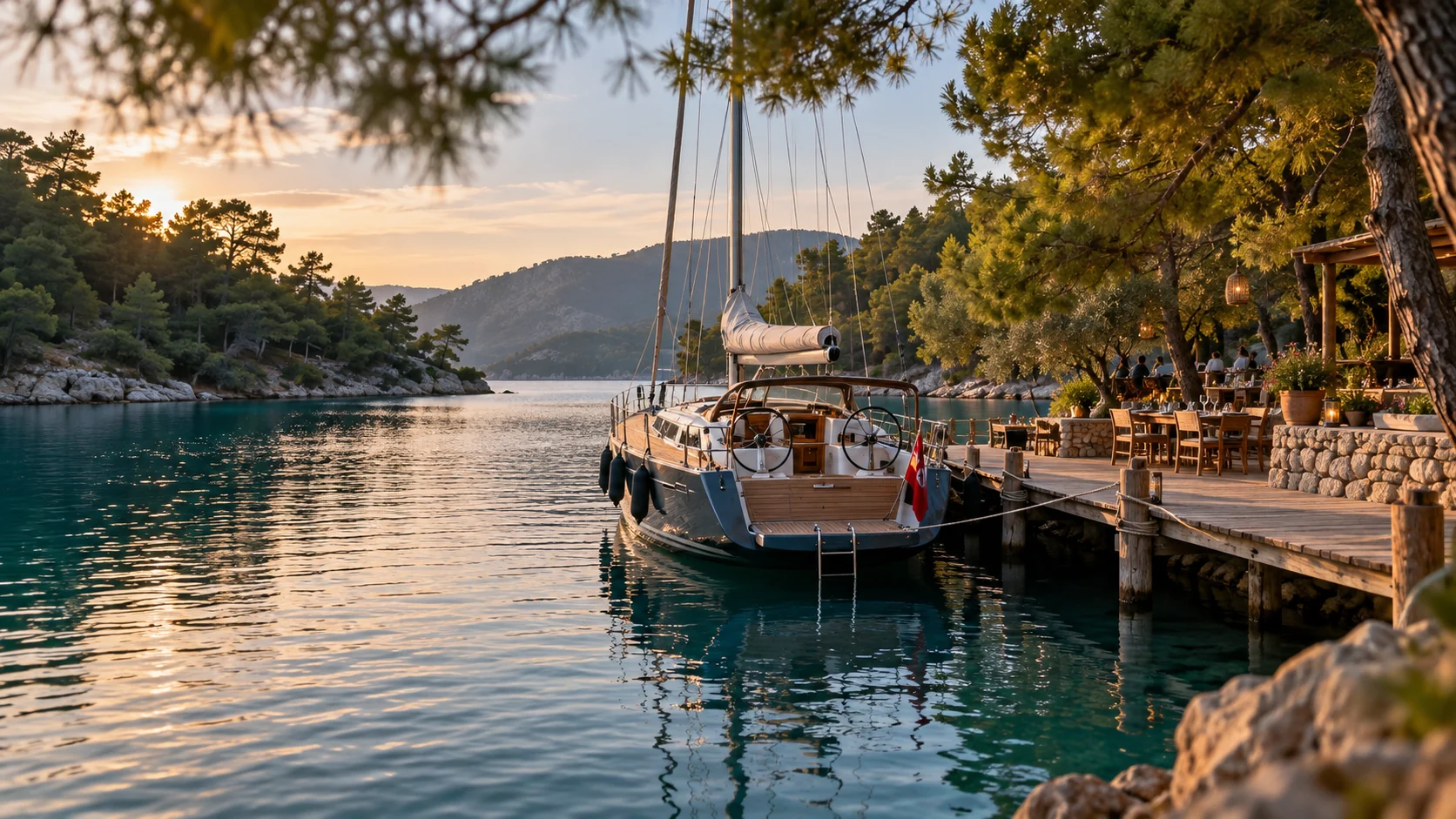
Chartering a catamaran generally comes down to two models:
Crewed charter: A professional captain (and usually additional crew) runs the boat. You simply enjoy the holiday. The vast majority of catamarans chartered in Turkey operate this way, for both safety and comfort reasons.
Bareboat charter: If you hold an adequate sailing/nautical qualification, you can skipper the boat yourself. It’s typically more budget-friendly, but Turkey generally requires an internationally recognized certificate (such as an ICC) for bareboat charter.
At Aquinox Yachting, we recommend crewed charter especially for first-time catamaran guests — you travel with a captain who knows the route, and you’re free to actually enjoy the holiday.
How Much Does It Cost?
Catamaran charter rates vary widely depending on the boat’s age, cabin count, equipment, and season. As a general guide:
- Standard catamarans (4 cabins, basic equipment): roughly €600–1,500 per day
- Mid-to-upper segment catamarans (newer model, air conditioning, water sports gear included): roughly €1,500–3,000 per day
- Luxury/larger catamarans (5+ cabins, jacuzzi, advanced electronics): €3,000–5,000 per day and up
Weekly charters generally offer a proportional discount over the daily rate, especially in shoulder seasons like May–June and September–October. July–August is peak season, so prices rise noticeably; booking early matters both for boat availability and for getting a better rate.
What’s usually included: fuel for the main route, captain/crew fee, port and mooring fees, and standard water sports equipment. What’s usually excluded: food and drink costs, extra fuel for longer routes, and gratuities.
Tipping is an item that’s easy to overlook when budgeting. It isn’t mandatory in Turkey, but the custom is roughly 5–10% of the total charter fee — especially if you’re happy with the service. Building this into your budget upfront avoids a surprise cost at the end of the trip.
A Day Aboard a Catamaran
For anyone who has never chartered a catamaran, knowing what a typical day looks like helps set expectations. Mornings usually start with the crew preparing breakfast while you enjoy the sun on deck. The captain confirms the day’s route with you based on that day’s weather and sea conditions — usually a distance of one or two bays, so you’re not spending the whole day underway. Around midday you anchor in a quiet bay for swimming, snorkeling, kayaking, or towable water sports. Lunch is typically served on deck, with the sea as your view.
In the afternoon, you either stay in the same bay to relax or move on to the next stop. Anchoring at a scenic point to watch the sunset is one of the most loved moments of any catamaran holiday. After dinner, some guests linger on deck under the stars while others retire to their cabins early.
This rhythm is entirely flexible — groups wanting a more active pace can visit 3–4 bays a day, while those after a slower holiday might spend days in a single bay.
Catamarans for Special Occasions and Group Events
A catamaran’s wide deck also makes it popular for special occasions. Birthday celebrations, proposals, bachelor/bachelorette parties, and small-scale corporate events all benefit from the privacy and scenery a catamaran offers compared to a venue on land.
Corporate groups in particular favor catamarans for a “different kind of meeting format” — a morning session followed by an afternoon of team water sports is an easy itinerary to put together. At Aquinox Yachting, we can also coordinate catering, decoration, and photo/video coverage for these kinds of events.
The Best Catamaran Charter Routes
Turkey’s southwest coast offers one of the world’s finest catamaran routes.
Bodrum and surroundings: bays like Türkbükü, Gümüşlük and Cennet Koyu (Paradise Bay) strike a good balance between nightlife access and quiet anchorages.
Gocek and the twelve islands: wind-sheltered bays surrounded by green forest make Gocek arguably the top pick for anyone after a calm, disconnected route. A catamaran’s wide deck feels especially good on these sheltered waters.
Gokova Gulf: combines historical ruins (like Cleopatra’s Bay) with striking natural beauty — genuinely enjoyable to explore by catamaran.
Marmaris to the Greek islands: a catamaran’s stability is a real advantage on short crossings to nearby Greek islands such as Rhodes or Symi.
Each region has its own character, and the right route depends largely on your priorities. Guests who choose Bodrum usually want proximity to restaurants and bars along the shore as well as the sea itself. Those who pick Gocek or Gokova are typically couples or families after a “switch everything off” experience, away from crowds. Marmaris works well as a practical starting point both for local bays and for extending the trip to nearby Greek islands.
What’s Included in the Standard Equipment?
Knowing exactly what your chartered catamaran offers helps set the right expectations. Most mid-to-upper segment catamarans include: air-conditioned cabins, a generator (for uninterrupted power/AC), a watermaker, a Bluetooth sound system, a wide sun-shaded deck, an exterior shower, and typically some water sports gear (snorkel set, kayak/SUP, towable ring).
Higher-end models add extras such as a jacuzzi, more advanced entertainment systems, a jet ski, and sometimes diving equipment. Requesting the full equipment list before booking lets you fairly compare boats against each other.
Advantages and Trade-offs of Catamaran Charter
To help you decide objectively, here’s a summary of the strengths and weaknesses.
Advantages: spacious living area, low roll (an advantage against seasickness), typically two separate deck levels (giving privacy), shallower draft allowing closer anchorage to some bays, and an excellent social space for larger groups.
Trade-offs: generally a somewhat higher charter cost than a monohull at the same budget, marina/port fees sometimes calculated by beam (width) which can add cost, and reduced maneuvering room in some narrower bays.
Most of these trade-offs are largely resolved by choosing the right boat and the right route — which is exactly where Aquinox Yachting’s brokerage service adds value.
What to Check Before You Book
1. Check the cabin and berth layout. Cabins aren’t always equal in size on every catamaran; clarify how your group will be distributed beforehand.
2. Ask about insurance coverage. Confirm what the boat’s insurance policy covers and how large the damage deposit is before booking.
3. Evaluate the galley/chef service. Some charters include a chef, others charge extra; factor this into your budget based on group size.
4. Discuss route flexibility. A good captain can optimize the route based on weather — ask whether this flexibility is part of the deal.
5. Check the water sports equipment. Whether snorkels, kayaks, and towable rings are included can vary significantly between boats.
6. Clarify the cancellation and weather policy. Find out in advance whether a booking can be postponed in case of a storm or poor conditions, and what the refund terms are.
7. Ask about Wi-Fi and connectivity. Internet access at sea can be limited; this matters if you’re planning to work remotely.
How Does the Booking Process Work?
Understanding the booking process makes the whole experience far less stressful for first-time charterers.
1. Needs assessment: your group size, dates, budget, and priorities (a relaxed holiday vs. an active route) are clarified.
2. Boat and route proposal: based on this, suitable catamaran options and a route proposal are presented.
3. Contract and deposit: once a boat is agreed, a charter contract is signed and typically a percentage of the total is taken as a deposit.
4. Check-in: on the day of charter, you meet the captain and crew aboard, receive a safety briefing, and confirm the route once more.
5. Holiday and check-out: the captain coordinates the daily plan with you throughout; at the end, the boat is handed back and any damage deposit is returned.
At Aquinox Yachting, we coordinate this entire process on your behalf — you deal with a single point of contact from your first message to the moment you step off the boat.
Chartering a Catamaran with Aquinox Yachting
Aquinox Yachting gives you access to a broad catamaran fleet across Gocek, Fethiye, Bodrum, and Marmaris. As a yacht brokerage, our job is to find the right boat for you — from cabin count to budget, from route preference to special requests (jet ski, private chef, corporate event, and more). We also handle concierge services such as port formalities, duty-free fuel supply, and maintenance coordination, so you can simply focus on your holiday.
Unlike platforms that list a single boat, we search across a wide network to find the option that genuinely fits your needs rather than squeezing your expectations into whatever one boat happens to offer. Whether it’s a weekend escape, a week-long family holiday, or a corporate event, we manage the process from start to finish.
Frequently Asked Questions
Do I need to be an experienced sailor to charter a catamaran?
No. Crewed charter requires no experience or certification at all — the captain and crew handle the entire operation. For bareboat charter, an internationally recognized sailing certificate (such as an ICC) is generally required.
How many people can a catamaran accommodate?
A standard catamaran comfortably hosts 8–10 guests (4 cabins plus crew quarters). For larger groups, 5–6 cabin models accommodating up to 12 guests are also available.
When is the best season to charter?
May–June and September–October offer the best balance of weather and price. July–August has the warmest weather and calmest seas, but also the highest prices.
Is a catamaran or a gulet the better choice?
It depends entirely on your priorities. A catamaran offers more living space, less rolling, and modern comfort; a gulet delivers a traditional wooden-boat atmosphere and a more “old-world sailing” feel. Families and guests sensitive to seasickness usually prefer the catamaran.
What’s included in the price and what isn’t?
Fuel for the main route, captain/crew fee, port fees, and basic water sports equipment are typically included. Food and drink costs, extra route fuel, and gratuities are usually charged separately. Always confirm the exact scope before booking.
Will I get seasick on a catamaran?
The twin-hull structure significantly reduces rolling compared to a monohull, which is why catamarans are generally the most comfortable option for guests sensitive to motion sickness.
How far in advance should I book?
For peak season (July–August), booking at least 2–3 months ahead is recommended, since popular boats fill up quickly. In shoulder season (May–June, September–October), shorter-notice bookings are generally still possible.
Is it suitable for families with young children?
Yes — a catamaran’s width and low rolling motion make it particularly suitable for families with children. That said, families should discuss basic safety measures (life jackets, care around deck edges) with the captain in advance.
Let us plan your route
Share your dates, group size and ideal holiday; we will shortlist the yachts and routes that fit.
Talk to a charter advisor


 English
 Turkish