
Everything you have learned anchoring in the Gulf of Gökova or off Göcek is wrong here, and it is better to say so at the start.
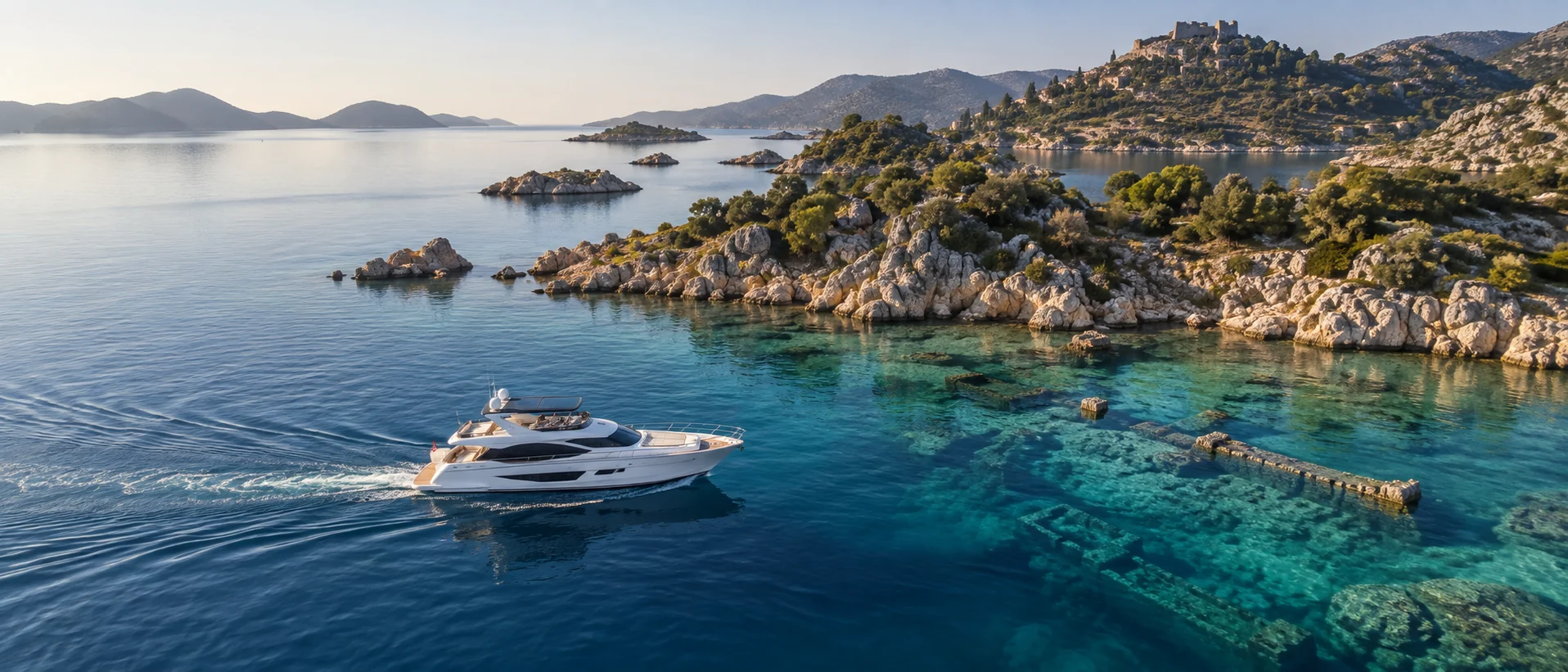
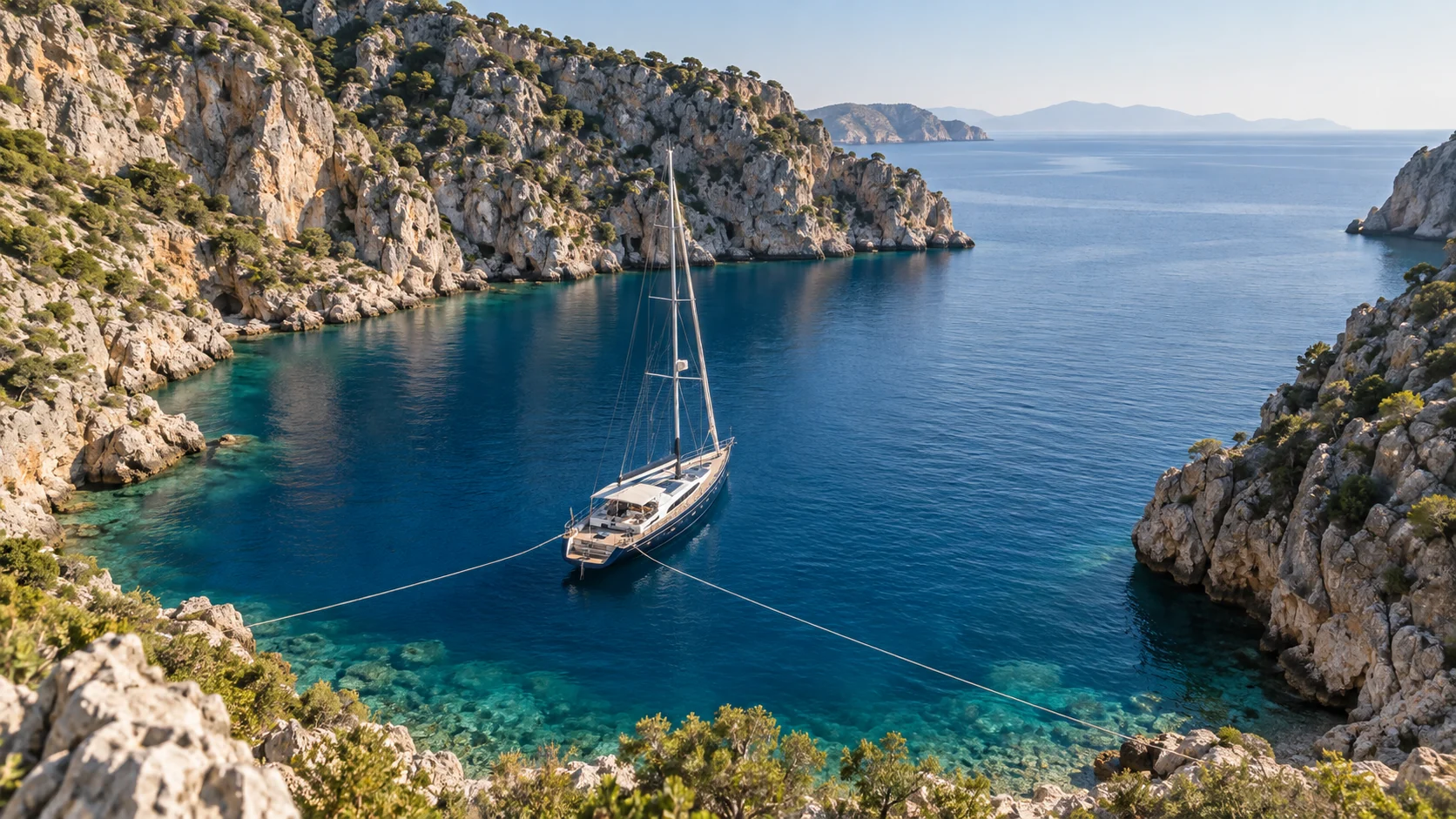
The Lycian coast east of Fethiye is tectonically drowned. The land subsided; the sea came in over it. What that means in practice is that the bottom falls away past forty metres within a boat length of the rocks, there is almost no five-to-ten-metre shelf anywhere, and the universal technique is to anchor deep and run two long lines ashore to rock bollards and tree trunks. Fifty to eighty metres of warp is routine, not exceptional. The bottom is often rock ledge under a skin of sand or seagrass, so the anchor must be placed by eye. And the Taurus wall behind the coast fires katabatic squalls of thirty and forty knots into coves that look completely sheltered.
Guests who have chartered Göcek find this alarming for about two days. Then they understand what they have been given in exchange: a coast with almost nothing built on it, water clear to thirty metres, a Byzantine city half-drowned along an island shore, and the best diving in Türkiye by a distance that is not close.
Distances are in nautical miles from Kaş harbour, timed at 8 knots for a gulet or Motor Sailer and 12 knots for a displacement motor yacht.
1. Arriving in Kaş
By air and road
Dalaman (DLM) is 150 km — two to two and a half hours — and is the closest practical airport. Antalya (AYT) is 195 km but takes about three and a half hours, which surprises people who look at the map.
The D400 is a two-lane coastal corniche: cliff-cut, tight, with sustained gradients and limited visibility through the Kumluca–Demre and Finike–Demre sections. It is a beautiful road and a slow one. Send guests by VIP transfer, not self-drive — this is not a hire-car coast for someone who has just flown in.
Road distances: Kalkan 27 km (30 min), Demre 40 km (45 min), Fethiye 101–110 km (about 2 hours).
Meis (Kastellorizo)
The Greek island sits about two and a half nautical miles offshore, and the passenger ferry crosses in seven to twenty minutes depending on the vessel — daily April to October, one to three times a week in winter, from around €17.50. No vehicles. Ticket offices face the old harbour, and passports are checked properly: Kastellorizo is an official Schengen entry and exit point.
Taking the yacht across is an entirely different proposition. Kaş is a designated port of entry and exit, which means you must close your Turkish transit log and clear out with customs, immigration, the harbour master and health before departure, clear into Greece at Kastellorizo, and open a new transit log on return — a full round of formalities each way, plus Greek cruising tax if you remain in Greek waters. Non-EU-flagged charter yachts and vessels under a Turkish commercial charter licence frequently cannot legally make this trip at all, depending on flag and licence. Verify in writing through the agent before it appears in a proposal. Nine times out of ten the right answer is: the yacht stays in Kaş and the guests take the ferry for the day.
Berthing
Kaş Marina (Setur/Makmarin) — VHF 73, about 470 wet berths and 160 hardstanding, basin depths of six to thirty metres, seven floating pontoons plus the breakwater face. All berths are on mooring lines; there is no anchoring inside. Fuel, water, 24-hour hawser boat and security, travel lift, laundry, pump-out, Wi-Fi. It sits about a kilometre east of the town and the old quarter is a comfortable walk.
On maximum LOA, be careful. Published figures conflict badly — one source gives 50 metres, Setur's own page says 120 metres, and the Superyacht Services Guide says 150. Fifty metres is the credible figure for an alongside berth; larger yachts most likely lie to the breakwater face by arrangement. Call the marina before committing anything over about 45 metres. We do this as a matter of course.
Kaş old harbour (Andifli) — the small municipal quay in front of the town, four to eighteen metres, fair holding, sheltered from north through east and open to southerly swell. Tenders and short stays.
Kalkan harbour — twelve to fourteen yachts stern-to the south-western quay with staff assistance. The holding is mediocre — lay thirty metres of chain or more — and a ground chain crosses the harbour centre. Water and power on the quay, charged; no showers or WC; fuel by tanker. Gulets and dive boats anchor perpendicular and foul early departures, so plan the morning accordingly.
Üçağız — a T-jetty for around twenty boats with water and power, plus restaurant pontoons. Kaleköy / Simena — three restaurant pontoons with water, power and Wi-Fi in four and a half to fourteen metres alongside, free if you dine.
2. Ashore: Lycia at Its Densest
Kaş is ancient Antiphellos, and the concentration of classical sites within an hour of the harbour is the highest anywhere on the Turkish coast.
In the town, free and unfenced: the Antiphellos theatre, twenty-six rows cut at the western edge of town facing the sea — the sunset spot, and empty most evenings. The King's Tomb (Aslanlı Mezar), a fourth-century BC Lycian sarcophagus standing on a plinth in the middle of Uzun Çarşı street, with the town built around it. And the Lycian rock tombs cut into the escarpment directly above the houses, up a stepped path.
Kalkan old town, twenty-seven kilometres west — Ottoman-Greek houses, bougainvillea lanes, and rooftop restaurants stacked above the harbour.
Patara — around €15. The bouleuterion, the restored assembly chamber of the Lycian League, which is as close to a parliament building as the ancient world produced and was cited by American constitutional theorists; the colonnaded main street; the triumphal arch; the theatre; and the lighthouse of Nero, built in AD 64 or 65, thirty metres tall, destroyed by tsunami and reassembled from around 2,500 original stones with only eight per cent new material. It is complete and open. Patara beach closes at 20:00 for loggerhead nesting — no vehicles, no night access, and this is enforced.
Xanthos (around €3) and Letoon — the Lycian capital and its federal sanctuary, together a UNESCO World Heritage site.
Myra at Demre (around €13) — the finest Lycian rock-tomb necropolis on the coast, cut in tiers into the cliff above a Roman theatre. The Church of St Nicholas (around €17, separate ticket) is a kilometre away: the fourth-century basilica of the bishop who became Father Christmas. Both open 08:30–19:30 in summer, and both covered by the Museum Pass Türkiye.
Simena / Kaleköy (around €4) — a Crusader-era fort above the smallest theatre in Lycia, around three hundred seats. The village is car-free and reachable only by boat, which is what makes it.
Aperlai — a remote walled Lycian port whose foundations run out under the water; snorkellable from Sıcak Koyu and about half an hour's walk from Polemos Bükü.
The Lycian Way — the 760-kilometre trail from Fethiye to Antalya. Kaş, Kalkan, Üçağız and Aperlai all sit on or beside it, and the Üçağız to Aperlai stage is about two hours and the best walk available from a yacht anywhere in Türkiye.
Museum fees on this coast are mid-transition from lira to euro pricing for foreign visitors and are re-tariffed annually. Confirm on the ministry portal at time of publication.
3. The Table: Meyhanes, Rooftops and a Sustainability Argument
Be accurate on this: there are no MICHELIN Guide listings in Kaş or Kalkan. The 2026 Türkiye selection covers İstanbul, İzmir, Muğla and Cappadocia — Antalya province is not in the guide at all. Anyone implying otherwise is selling. The cooking here is genuinely good and does not need the borrowed credibility.
The destination tables
Kaya Koruğu, Kaş — Mediterranean fine dining with sunset sea views. The town's benchmark.
Taşra, on the Çukurbağ peninsula — chef Hilal Tildirim, who left finance to cook her grandmother's Antalya recipes. Slow-risen breads and vegetable-led starters.
L'Apéro, Arısan Sokak — French and Riviera; the fresh tomato tart, and the best cocktails in town.
Oburus Momus, Kaş — chef Belkis Öztürk, and the region's first vegetarian restaurant, built on tarhana and fermentation.
Mezetaryen, Kaş — Simge Manacıoğlu's wine and meze bar, with sustainable sourcing that includes lionfish, the invasive Lessepsian species now cooked deliberately to reduce its numbers. Order it; the argument is a good one and the fish is excellent.
Villa Mahal, Kalkan — hotel dining on the beachfront terrace above the bay. The classic Kalkan splurge. Aubergine on Kalkan harbour for international and Ottoman cooking, and Salonika 1881 in the old town.
Kalkan's identity is its rooftop terraces above the harbour. Book the sunset seatings well ahead in July and August.
The meyhanes
All in Andifli, the old quarter, and all in the rakı-and-meze format that is the correct way to eat in this town.
Nereid Meyhanesi — the orange octopus and the sea bass patties. Çakır Meyhane — octopus mezes. Sardelaki — a Greek taverna: octopus, herb roast, shrimp. Üzüm Kızı — the long-running local favourite. Zaika Ocakbaşı — open grill and şaşlık. Bi'Lokma — traditional Turkish by the harbour.
The boat-in register
Üçağız and Kaleköy — a line of family restaurants on stilted terraces with their own pontoons. Berth free in exchange for dinner. Kaleköy's sit directly under the castle and are reachable only by boat; the village is car-free, provisioning arrives by sea, and the menus are consequently short and seasonal, which is a recommendation rather than a warning. Fresh fish, çöp şiş, home-made gözleme, grilled octopus.
Gökkaya has a small shore establishment. Polemos Bükü has a small restaurant.
What to eat
The western Antalya register is distinct from the Aegean and worth ordering deliberately:
- Tahinli piyaz — Antalya's signature, and the dish that surprises people: white beans dressed with tahini, not olive oil, with tuna, egg and tomato.
- Hibeş — a tahini, cumin, garlic and lemon dip, chilli-spiked. Regional and excellent.
- Domates civesi — a soupy tomato-and-egg breakfast dish.
- Kaş orange octopus — slow-cooked, and the meyhane signature.
- Lionfish — see Mezetaryen above.
- Sıkma — a thin yufka wrap with cheese and herbs. The Lycian Way's own food.
- Tarhana — the dried wheat-and-yoghurt ferment behind the winter soup and behind Oburus Momus's whole menu.
- Tahini stone-ground at traditional water mills in the district, and olive oil pressed from green November olives — mild and low-acid.
- Yörük cheese — brined nomad cheese, and the herb-studded artisanal rounds.
- Likya Winery wines, reviving the ancient Anatolian varietals acıkara and fersun.
- Produce: greenhouse tomatoes and peppers from the Demre belt, Finike oranges, pomegranate, carob, Taurus honey, wild kekik and adaçayı, almonds and figs.
4. Anchorages: Deep Water and Lines Ashore
How anchoring works here
Read this before the list, because it changes every calculation.
The technique is anchor in ten to twenty-five metres and run two long lines ashore to rock bollards or trees. Fifty to eighty metres of warp is normal. The bottom is frequently rock ledge under a thin skin of sand or Posidonia, so the anchor must be placed visually, not dropped on a sounder reading. And the Taurus wall generates violent katabatic gusts in coves that look perfectly protected — Polemos Bükü is documented at gusts easily reaching forty knots. A cove being sheltered from the synoptic wind tells you nothing about what comes down the mountain at two in the morning.
The upside is that a crew who can do this properly has access to anchorages nobody else uses.
The anchorages
| Bay | ~NM | Use | Notes |
|---|---|---|---|
| Küçük and Büyük Çakıl | 0.3–0.8 | Day | Pebble coves under the town, 3–10 m, sand and pebble. Swim stop. |
| Bucak Denizi | ~1 | Day, calm overnight | The inlet behind the Çukurbağ peninsula. 5–15 m, good holding, quiet. |
| Limanağzı | ~1.5 | Day, overnight in calm | A dramatic fjordlet east of town. 10–30 m over rock, fair holding — lines ashore essential. Beach clubs; an Ottoman wreck and the C-47 dive site are here. |
| Kaputaş | ~7 | Day only | The gorge-mouth beach. No shelter, deep to the shore, and crushed with day boats from ten. Go at eight. |
| Ufakdere | ~10 E | Day or overnight | Quiet sandy cove, 4–12 m, shelter from N/NE/NW. |
| Kalkan | ~10 | Overnight | Harbour berthing preferred; anchor holding is poor. |
| Patara | ~16 | Day, settled only | An open roadstead off twelve kilometres of sand. Swell-prone, no shelter. |
| Kekova Roads | ~18 | Overnight | 4–12 m sand, good holding, protection from most quarters. Very busy. |
| Üçağız (Teimiussa) | ~19 | Overnight — the best all-weather hold on this coast | A landlocked lagoon that is always calm. 6–7 m mud in the western arm; it may take three or four attempts to set. Poor water clarity — this is where you sleep, not where you swim. |
| Kaleköy (Simena) | ~19 | Overnight on a pontoon | Mud and weed over rock; holding is not secure. Reefs on the approach. Take a restaurant pontoon and do not argue with it. |
| Tersane Koyu, Kekova island | ~20 | Day; overnight after 20:00 | A tiny cove at the Byzantine shipyard and apse. 4–5 m sand and rock, good holding, lines ashore both sides. Day boats occupy it 09:00–20:00. |
| Polemos Bükü | ~21 | Overnight with caution | 5–10 m soft mud that drags. Very protected from the synoptic wind and subject to gusts easily reaching 40 knots. Line ashore. Small restaurant. |
| Karaloz, southern Kekova | ~21 | Overnight | Completely landlocked and secluded, mud and weed, good holding. Strong gusts; line ashore. |
| Aperlai / Sıcak Koyu | ~21 | Day | Shallow and ruin-strewn, snorkelling over sunken walls. Exposed to the south. |
| Gökkaya Limanı | ~22 | Overnight | A deep-water inlet system behind islets — 10–20 m in the approaches, 3–7 m in the pockets, good holding on mud and sand, all-round shelter. Reefs demand care on entry. |
| Meis / Kastellorizo | ~2.5 | Overnight, with clearance | A foreign port. See section 1 before planning it. |
Andifli is Kaş's own old-town harbour quarter and Yeşilköy is a village west of town — neither is a separate anchorage, contrary to some published lists.
Kekova and the rules that govern it
The sunken city (Batık Şehir) runs along the northern shore of Kekova island: quays, staircases and house walls drowned by the subsidence that followed the earthquakes of the second century AD. You can see the steps going down into clear water and continuing.
Swimming, snorkelling, diving and anchoring over the sunken city are prohibited. Boats transit without stopping; you look from the deck. Diving over the ruins is banned outright — the reasoning is anchors and fins against two thousand years of fabric, and it is sound. Landing on Kekova island itself is restricted.
The legal ways to see it properly: transit slowly by boat, sea kayak, which is the classic local experience and much the best of the three, or the panorama from Simena castle above Kaleköy.
The whole area sits inside the Kaş-Kekova Special Environmental Protection Area, declared in 1990 and layered with first-degree archaeological site protection. The precise boundary of the swimming restriction is not published in a form we can verify — some operators swim-stop at Gökkaya, just outside the zone. Take the boundary from a local operator or the protection directorate, not from a guidebook.
5. Diving: The Real Reason to Charter Kaş
Kaş is Türkiye's principal dive destination and it is not a close contest. Twenty-eight mapped sites, a season running roughly April to November, summer water above 25°C, and visibility often measured in tens of metres. Almost every site is ten to thirty minutes from the harbour, so a yacht can run two dives and be back at anchor by mid-afternoon.
The sites worth planning around
The Uluburun replica — Hidayet Bay Underwater Archaeopark, maximum 32 m. A full-scale replica of the Late Bronze Age Uluburun ship, sunk as an artificial reef with imitation cargo laid out in situ. The original wreck — around 1320 BC, excavated off this coast between 1984 and 1994, and now in the Bodrum museum — is the most important Bronze Age wreck ever found. Diving the replica after seeing the original in Bodrum closes a circle that very few charters manage.
The Canyon and the Dimitri wreck — 20 to 30 m. A steel coaster lost in 1968, locally nicknamed "Cotton", with a cave of button coral and red shrimp. Mediterranean monk seal habitat.
Limanağzı — the sunken plane — 22 m. A Second World War C-47 Dakota with a twenty-nine-metre wingspan, sunk deliberately as an artificial reef, plus an Ottoman wooden wreck with an intact clay pot at 23 m.
Flying-fish Reef — an Italian Savoia-Marchetti SM.79 torpedo bomber at 55 to 71 m. Technical and expert only, with strong current.
Neptune – Three Rocks — 8 to 33 m; the former coastguard cutter TCSG-119 at 33 m and an amphora field from 20 m.
Sarıot Island south wall — the best wall in Kaş: pink anthias and large grouper.
Also The Big Cave (27–40 m+), Cape Çoban Tunnel, Besmi Island with pithoi and ancient anchors, Kovanlı Island, Heybeli, Camel Reef, Pigeon Island for beginners, Anchor Reef, Gürmenli Rocks, Oasis Reef and Pen Shell Reef.
Marine life: dusky and mottled grouper, dentex, amberjack, barracuda, bonito, moray, octopus, loggerhead turtles, rays, seahorses, Lessepsian migrants, and Posidonia meadows. The Mediterranean monk seal is present — Cave II is a designated seal refuge and reputable operators do not enter it.
Operators: Dragoman Diving & Outdoors, Blue Team Diving, Nautilus Diving Kaş, Kaş Diving.
The rules that actually apply
This section exists because getting it wrong is a criminal matter, not an inconvenience.
- Certification from a recognised agency is required, and foreign recreational divers generally must dive with a certified local guide.
- Commercial operators must notify the authorities in advance.
- Decompression diving is prohibited recreationally. Lift bags are banned without authorisation.
- Diving is forbidden in military zones and protected archaeological sites — which includes the Kekova sunken city.
- Dives normally operate from Turkish-registered vessels. A foreign-flagged charter yacht needs specific permission to run dives from its own deck, and this must be arranged in advance.
- Removing or raising antiquities is a serious criminal offence. Nothing comes off the seabed. Not a sherd.
The practical consequence for a charter: book the diving through a licensed Kaş operator and dive from their boat, and let the yacht be the hotel. It is simpler, it is legal, and the operators know where the grouper are.
6. Four Route Alternatives
Route One — Kaş and Kekova · 7 nights · ~70 NM
The definitive Lycian week, and short legs throughout — the distances here are modest and the interest is dense.
| Day | Leg | NM | 8 kn | 12 kn | Night |
|---|---|---|---|---|---|
| 1 | Kaş Marina → Limanağzı | 1.5 | 0h15 | 0h10 | Limanağzı |
| 2 | Limanağzı → Kaputaş (early swim) → Kalkan | 6 + 3 | 1h10 | 0h45 | Kalkan |
| 3 | Kalkan → Kaş (dive day) | 10 | 1h15 | 0h50 | Kaş Marina |
| 4 | Kaş → Ufakdere (lunch) → Üçağız | 10 + 9 | 2h25 | 1h35 | Üçağız |
| 5 | Üçağız → Kekova transit → Tersane Koyu → Kaleköy | 4 + 3 | 0h55 | 0h35 | Kaleköy (pontoon) |
| 6 | Kaleköy → Aperlai (day) → Gökkaya | 2 + 4 | 0h45 | 0h30 | Gökkaya |
| 7 | Gökkaya → Polemos Bükü (lunch) → Üçağız | 2 + 3 | 0h40 | 0h25 | Üçağız |
| 8 | Üçağız → Kaş | 19 | 2h25 | 1h35 | Disembark |
Day two starts at seven. Kaputaş is one of the most photographed beaches in Türkiye and it is crushed with day boats from ten o'clock. Anchor off at eight, swim, and be gone before the fleet arrives. Then Kalkan for the night and dinner on a rooftop above the harbour.
Day three is the dive day. Back to Kaş, berth in the marina, and go out with a licensed operator for two dives — the Uluburun replica in the morning and the C-47 at Limanağzı after lunch. Non-divers get the Antiphellos theatre and the King's Tomb, which take an afternoon and cost nothing.
Day five is the day of the charter. Leave Üçağız early, transit the sunken city slowly along Kekova's northern shore — no stopping, no swimming, no anchoring, and the rule is not negotiable — then Tersane Koyu for the Byzantine shipyard and the standing apse, with lines ashore on both sides. Come out before the day boats arrive at nine, or accept that you are sharing it. Night on a pontoon at Kaleköy, under the Crusader castle, in a village with no cars and no road, where dinner came in by boat that morning. Walk up to the castle before sunset for the view over the sunken city; it is the legal panorama and it is the best one.
Day six is for the tender and the walking boots: Aperlai, snorkelling over the sunken walls of a Lycian port, then the two-hour Lycian Way stage back, with the yacht repositioning to meet you at Gökkaya.
Note the last leg. Nineteen miles back to Kaş is the longest day of the week — run it in the morning.
Route Two — The Long Weekend · 3 nights · ~45 NM
For guests with three days who want Kekova and nothing else.
Kaş → Ufakdere → Üçağız → Kekova transit → Kaleköy → Gökkaya → Kaş.
One dive on the first afternoon, the sunken city on day two, Simena castle at sunset, and a long morning leg home. It is the tightest good itinerary in this series.
Route Three — Kaş to Fethiye · 10 nights · ~110 NM · one-way
Westbound, and the natural direction for a charter that ends where the airport is closer.
Kaş → Kaputaş → Kalkan → Patara → Kabak → Ölüdeniz → Kelebekler Vadisi → Gemiler Adası → Fethiye.
The coast softens as you go west. Patara is an open roadstead and settled weather only, but a morning ashore among the colonnades, the bouleuterion and Nero's lighthouse is worth the risk of a rolly anchor. Past Kabak the character shifts again, and from Ölüdeniz onward you are in the gulf's protected water and everything gets easier. The Babadağ massif fires down-gusts into the Ölüdeniz and Kabak shore in the late afternoon — run that stretch in the morning. Full detail in the Fethiye guide.
Route Four — The Dive Charter · 7 nights · ~50 NM
Built around the water rather than the shore, and the itinerary that no other Turkish destination can offer.
Kaş (base) → Limanağzı → Kaş → Üçağız → Gökkaya → Kaş.
Two dives a day from a licensed operator's boat, with the yacht repositioning to meet the divers and the non-diving half of the party doing the Lycian sites, the meyhanes and Simena. Morning dives, afternoon anchoring, evening ashore. The rhythm works because the sites are close and the water stays warm into November.
We plan these with the operator directly and build the dive schedule into the charter contract, because the alternative — arranging it on the day — costs the party a morning every time.
7. Season, Wind and Water Temperature
The meltem is an Aegean phenomenon and largely spends itself before it reaches here. East of Fethiye the Lycian coast runs on a thermal land-and-sea-breeze cycle instead: calm mornings, an onshore breeze filling from the west or south-west around 11:00 to 13:00, peaking between 15:00 and 18:00 at roughly Force 3 to 5, then dying at dusk. Morning passages, afternoon anchoring is the rhythm, and every route above is built on it.
The complication is the Taurus wall behind the coast, which amplifies katabatic gusting into cove-specific squalls of thirty to forty knots with no synoptic warning at all. This is why lines ashore are not optional here.
Kaş is warmer than the Aegean and stays swimmable considerably later — this is not marketing, it is measurable. Sea temperatures: January to March 15–16°C; April to May 18–20°C; June 22–24°C; July to August 26–28°C; September to October 23–25°C; November to December 17–19°C. While Bodrum drops to around 22°C in October, Kaş holds 23 to 25, and diving runs into November. Comfortable swimming realistically runs from late May to early November — roughly six weeks longer at each end of the season than the Aegean coast.
- Late May and June — warm enough, quiet, and the wild herbs are out. The best value of the year.
- July and August — hottest, busiest and breeziest. Kekova is crowded between nine and six; anchor early and late.
- September and early October — near-July water with June's crowds. The professionals' answer.
- Late October and November — the diving season's best visibility and almost nobody else afloat.
8. Chartering from Kaş with Aquinox
Aquinox Yachting is a TÜRSAB-certified brokerage and charter house operating across the Turkish Riviera, with full agency capability through our partnership with UCT Agency: berthing at Kaş Marina, port clearance and transit logs, dive-operator coordination and permissions, digital waste compliance, provisioning and crew placement.
We do not publish vessel names. Our fleet is presented by specification and code, and the right yacht is proposed after we understand the party. Kaş carries one requirement that the western coast does not: the crew must be able to anchor deep and run lines ashore competently, every night, often in the dark. This is not a coast for a delivery skipper. We staff it accordingly, and it is the first thing we check when a client asks for a Lycian itinerary.
Request a Kaş charter proposal — or read the series from the beginning with our Bodrum route guide.
FAQ
Frequently Asked Questions
Can I swim or dive at the Kekova sunken city?
No. Swimming, snorkelling, diving and anchoring over the sunken city are prohibited, and landing on Kekova island is restricted. Boats transit without stopping. The legal ways to see it are from the deck, by sea kayak, or from Simena castle above Kaleköy — and the kayak is the best of the three.
Why is anchoring different in Kaş?
The coast is tectonically drowned, so the bottom falls past forty metres within a boat length of the rocks and there is almost no shallow shelf. You anchor in ten to twenty-five metres and run two long lines ashore — fifty to eighty metres of warp is normal. The bottom is often rock under thin sand, so the anchor is placed by eye, and the mountains behind fire katabatic gusts of thirty to forty knots into coves that look sheltered.
Is Kaş good for diving?
It is the best in Türkiye by a clear margin: twenty-eight mapped sites, an April-to-November season, and visibility often in the tens of metres. Highlights are the full-scale Uluburun replica in the underwater archaeopark, a C-47 Dakota at 22 metres and the Dimitri wreck. Book through a licensed Kaş operator and dive from their boat — a foreign-flagged yacht needs specific permission to run dives from its own deck.
Can I take the yacht to Meis (Kastellorizo)?
Possibly, and possibly not. Kaş is a port of entry and exit, so the crossing requires closing your Turkish transit log, clearing out with four authorities, clearing into Greece, and opening a new transit log on return. Non-EU-flagged yachts and vessels under a Turkish commercial charter licence often cannot legally make the trip at all. Verify in writing through the agent. For most charters, sending guests over on the passenger ferry — seven to twenty minutes — is the better answer.
What is the best anchorage near Kekova?
Üçağız for shelter — a landlocked lagoon that is always calm, though the water is murky and it may take several attempts to set. Kaleköy for the evening, on a restaurant pontoon under the castle. Gökkaya for all-round shelter behind the islets. Tersane Koyu on Kekova island is the best day stop, with lines ashore both sides.
When is the sea warmest in Kaş?
July and August at 26–28°C, but September and October hold 23–25°C, which is warmer than the Aegean at the same time of year. Comfortable swimming runs from late May to early November, and the diving season into November.
Are there Michelin restaurants in Kaş or Kalkan?
No. The 2026 MICHELIN Guide Türkiye selection does not cover Antalya province at all. The cooking is very good regardless — the Kaş meyhanes for octopus and rakı, Mezetaryen for the lionfish, and the Kalkan rooftops for a sunset.
How long is the drive from the airport?
Dalaman is two to two and a half hours; Antalya is about three and a half despite being closer on paper. The D400 is a slow cliff road. Use a transfer, not a hire car.
What does a Kaş charter cost?
It depends on vessel, season and party size, and any figure quoted without those is fiction. A dive-led charter carries operator costs on top. We build proposals against the itinerary. Ask us.


 English
 Turkish