
Marmaris has a reputation problem among people who have only seen it from the shore, and it is worth dealing with in the first paragraph.
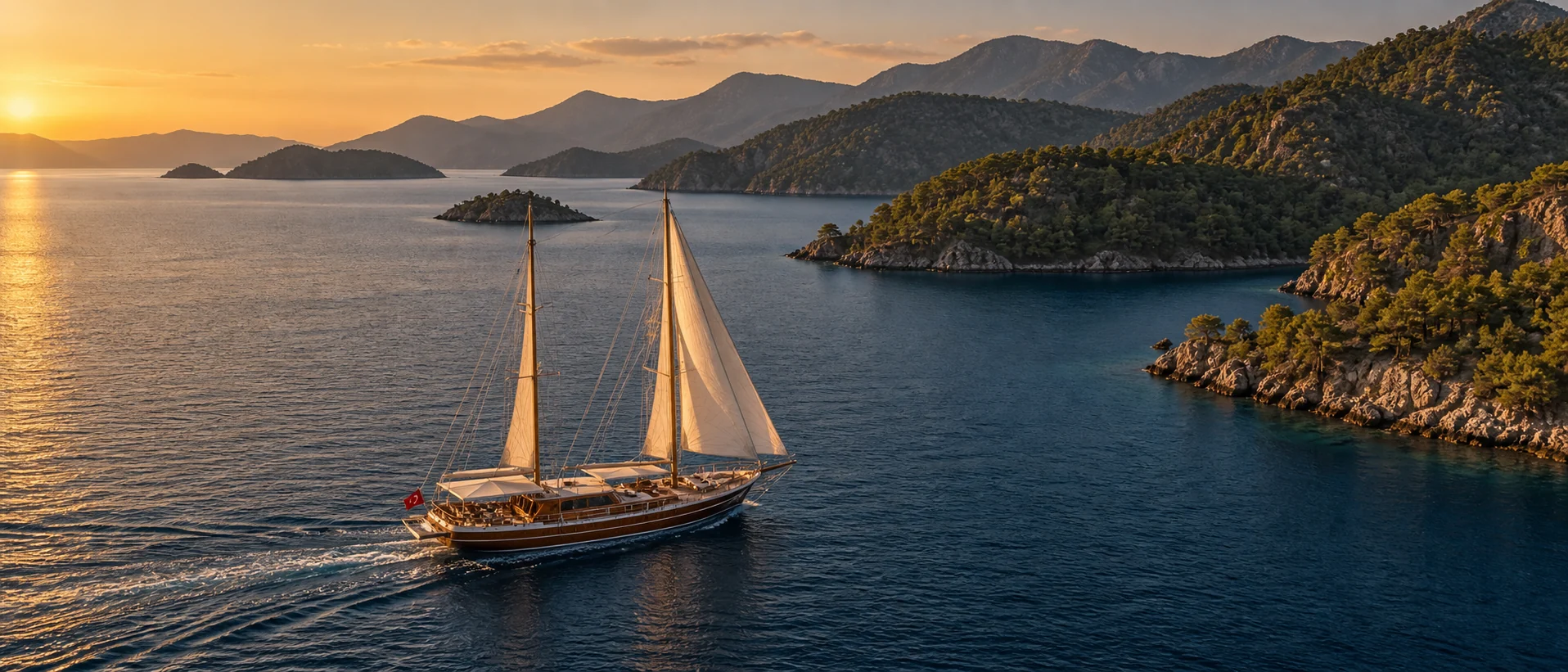
The town is loud. The bars on the strip are not for the client who has just paid for a week on a fifty-metre yacht. But the town is not why anyone charters here, and treating Marmaris as a destination rather than a gateway is the mistake. What Marmaris has is the largest marina complex on the Turkish coast, a refit yard that services half the region, an hour's ferry to Rhodes, and — three miles past the harbour entrance — the Gulf of Hisarönü: a deeply indented, pine-walled, almost entirely undeveloped cruising ground with better shelter than Gökova and a fraction of the traffic.
Add the Bozburun peninsula, where gulets are still built by hand on the waterfront and the ancient fortress of Loryma stands over a bay with nothing else in it, and the case is complete. Marmaris is where you start from, not where you stay.
Distances are in nautical miles from Netsel Marina, timed at 8 knots for a gulet or Motor Sailer under power and 12 knots for a displacement motor yacht.
1. Arriving in Marmaris
By air and road
Dalaman Airport (DLM) is about 90 km from Marmaris — roughly 1 hour 30 minutes, and longer in August. Add fifteen to twenty minutes for the marinas on the southern side of the bay, and reckon on two hours to Martı Marina at Orhaniye in the Gulf of Hisarönü.
Milas–Bodrum (BJV) is 120 km and about 2 hours 10 minutes — relevant only if the itinerary starts in Gökova and ends here.
By road: Orhaniye 25 km (35 min), Selimiye 42 km (1 h), Bozburun 50 km (1 h 10, winding), Datça 72 km (1 h 15), Fethiye 130 km (2 h).
The Rhodes ferry
A high-speed ferry runs Marmaris–Rhodes in about an hour, daily from March to November and three to seven times a week off-season. The Turkish terminal is on Mustafa Münir Elgin Bulvarı, roughly a hundred metres past the Netsel entrance; the Greek side lands at the Tourist Port beside the Old Town.
For guests, the ferry is almost always the right answer. Taking the yacht is a different proposition entirely — see section 6.
The marinas
Marmaris has the deepest berthing capacity on this coast, and the names are routinely confused. To be precise:
Netsel Marmaris Marina (Setur) — 701 sea berths plus 70 ashore, maximum LOA 90 metres, depths of 3.5 to 18 metres across nine floating docks, fuel, 24-hour security, waste reception. VHF 72, working as "Port Marmaris". Five hundred metres from the town centre. This is the prime superyacht berth and the standard charter start.
Marmaris Yacht Marina (Yacht Marine), Adaköy — around 750 berths and a 330-tonne travel lift in a large self-contained boatyard, with a heliport. Across the bay, and the region's principal refit yard.
Adaköy Marina — 200 berths, yachts to 150 metres alongside or stern-to, a 75-tonne hoist, 400-amp power and Blue Flag status. Twenty minutes from town by car or water taxi.
Albatros Marina — small, currently around 44 berths, with a 30,000 m² dry yard. Not superyacht-capable.
Martı Marina, Orhaniye (Keçi Bükü) — in the Gulf of Hisarönü rather than Marmaris bay, with fuel, water, 220 V, laundry, chandlery, travel lift and a shuttle to Marmaris in about twenty minutes. Excellent all-weather shelter at the gulf head, and the natural mid-charter provisioning and crew-change point.
A correction worth carrying. "Marmaris Yacht Marina" and "Albatros Marina" are two entirely separate businesses, and "Yat Marin" is not a fifth marina — it is the same Yacht Marine at Adaköy. This gets confused constantly, including in published charter listings.
2. Ashore: The Castle, the Isthmus and the Boatyards
Marmaris Castle and Museum — built in 1522 as the staging point for Süleyman the Magnificent's campaign against Rhodes, and a museum since 1991. Bronze Age to Ottoman, with underwater amphorae and finds from Knidos. Open 08:30–18:45 daily with no closing day; evening visits 19:00–22:00 in season.
Kaleiçi, the old town — the lanes below the castle, with boutique hotels and meyhanes. Ten minutes' walk from Netsel, and a different town entirely from the strip.
Hafsa Sultan Caravanserai (1545) — a restored Ottoman han beside the castle, now shops and cafés.
Amos — a Hellenistic theatre and temple terrace on the ridge above Kumlubükü, unfenced and free, up a steep fifteen-minute climb. The theatre looks straight down into the bay you have just anchored in, which is the whole point of going.
Nimara Cave, on the Cennet peninsula inside Marmaris National Park — a thirty-minute walk to three-metre stalagmites and evidence of occupation around twelve thousand years ago.
Kızkumu at Orhaniye — a natural sandbar running some six hundred metres out into Keçi Bükü, shallow enough that a walker appears to be crossing the open sea. Wade it; do not remove the pebbles, and do not believe the legend, which is charming and entirely invented.
The Bozburun boatyards — working yards still building traditional gulets by hand on the waterfront. Ask before photographing; these are workplaces, not an attraction.
Turgut Waterfall — thirty-five kilometres out, natural pools, small entry fee, best from May to July.
The Datça road viewpoints — the D400 ridge above the Bencik isthmus, where both gulfs are visible at once. Two minutes' stop, and the best explanation of the region's geography anyone will get.
3. The Table: Jetties, Not Restaurants
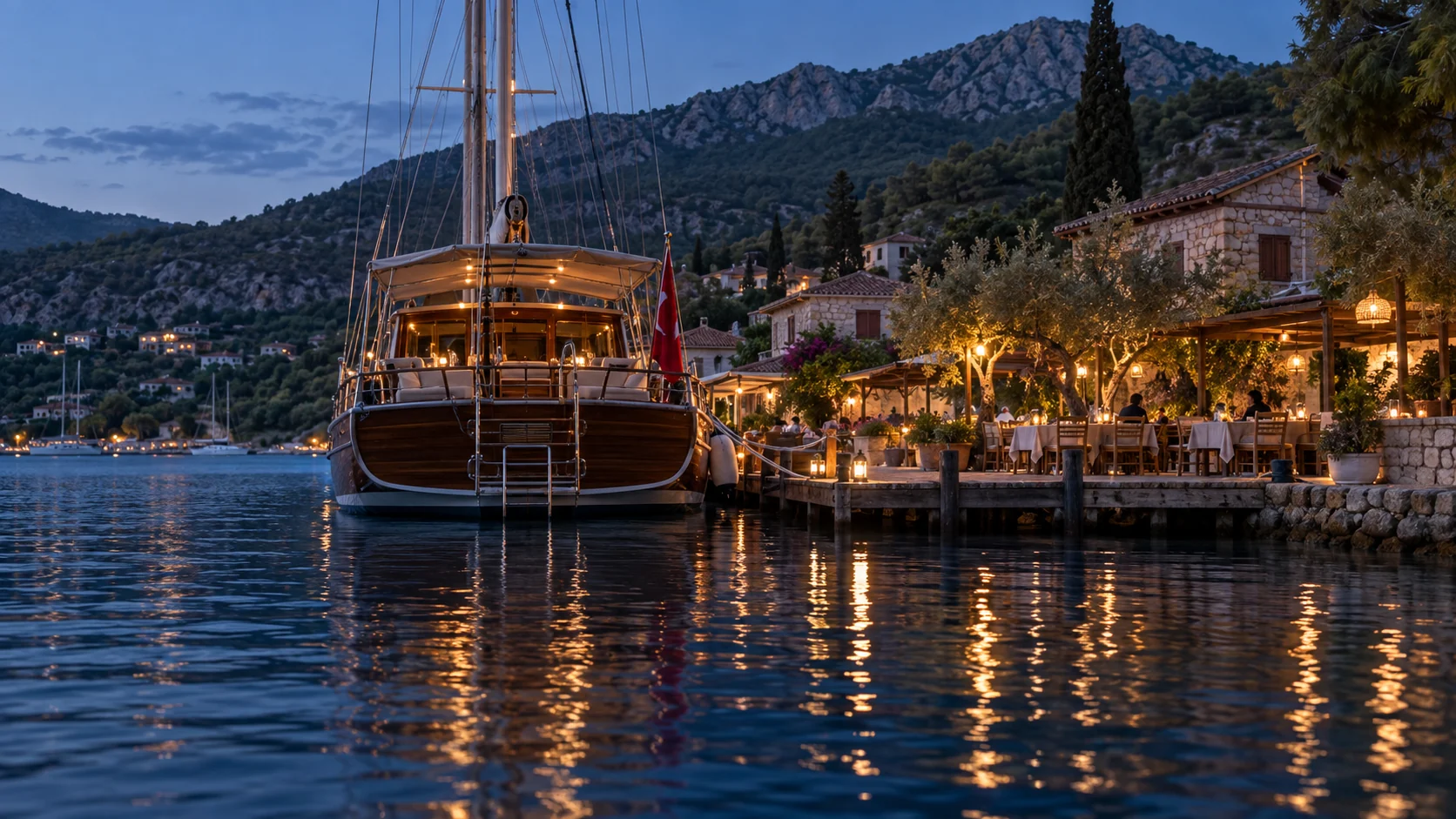
Marmaris town dines conventionally. The interesting eating on this coast is in the Gulf of Hisarönü, where the format is a wooden jetty, a family, and whatever the boat brought in.
Be clear on one thing before proposing this region for gastronomy: there are no MICHELIN Guide listings in Marmaris, Bozburun or Selimiye. Muğla's entries in the 2026 selection are all on the Bodrum peninsula. Anyone implying otherwise is selling.
The jetty tables
Selimiye — the best concentration on the gulf. Aurora takes yachts on mooring lines in two and a half to three and a half metres, with water, power and Wi-Fi; Sardunya is a hundred and ninety metres along and runs a hotel as well. The town quay handles the overflow. Selimiye is a quiet fishing village that has resisted the strip entirely, and an evening here is the argument for the whole gulf.
Bozukkale (Loryma) — three establishments share the bay: Loryma Restaurant with fifteen moorings and eight buoys, Sailors House with eighteen jetty berths and ten moorings, and Ali Baba with twenty. Book by phone. You eat under a Hellenistic fortress with no road to it.
Ekincik — My Marina Yacht Club takes around seventy boats, and is the base for the Dalyan river trip.
Çiftlik — arbour restaurants along the beach, informal, good.
Kumlubükü Yacht Club — the upper end of the register: Turkish and Japanese cooking with a T-shaped pier for fifteen to twenty boats carrying water and power. Confirmed operating for 2026.
Martı Marina, Orhaniye — the marina restaurant and bar, and the easy option on a crew-change night.
Bozburun Yacht Club — hotel and restaurant on the Bozburun waterfront.
In town
Queen Steakhouse & Fish at Netsel for dry-aged beef and seafood; Bono Good Times Marine marina-side for Italian; Vamos Beach on Uzunyalı with a private pier. Jan De Wit and Karen's Kitchen for the expatriate register that Marmaris does well and quietly.
What to eat
- Marmaris pine honey (çam balı) — the region's defining product and worth understanding. It is not a nectar honey: bees collect honeydew produced by the Marchalina hellenica scale insect on red pine. Türkiye produces around 92% of the world's pine honey and Muğla around 80% of Türkiye's — which means this bay supplies most of the global supply of a food most people have never heard of. Dark amber, resinous, barely sweet. Eat it with kaymak.
- Bozburun honey — a thyme and pine blend off the peninsula's maquis. Scarcer, and sold village-direct rather than in shops.
- Çökertme kebabı — the Muğla signature: beef over matchstick potatoes with yoghurt and tomato butter.
- Ekşili balık — fish in a sour tomato sauce, an old coastal preparation.
- Kefal dolması — stuffed grey mullet, increasingly rare and worth ordering where you find it.
- Ahtapotlu pilav — octopus rice.
- Deniz börülcesi — samphire, blanched, with olive oil and garlic. The correct standing meze all summer.
- Tarhana çorbası, höşmerim and Muğla saraylısı for the inland register.
- Seafood: bream, bass, red mullet, octopus, calamari and Bozburun-landed grouper.
4. Bays and Anchorages
Three separate cruising grounds meet at Marmaris, and it is worth being precise about which is which — published itineraries confuse them constantly.
The Marmaris and outer coast
Cennet Adası (~2 NM) — inside the national park; a day stop.
Akvaryum Koyu (~3 NM) — clear water, no shelter, and thick with tripper boats by ten. Early morning only.
Turunç (~5 NM) — day or overnight, open to southerly and south-westerly swell.
Kumlubükü (~6.5 NM) — a good overnight with the Yacht Club pier, and Amos on the ridge above.
Kadırga (~9 NM) — exposed; day stop.
Çiftlik (~12 NM) — overnight, with beach restaurants.
Gerbekse (~14 NM) — Byzantine chapels on the shore, open to the south, settled weather only.
Ekincik (~20 NM) — a good overnight, sheltered from strong southerlies, with My Marina. The base for Dalyan.
The Bozburun outer side, toward Symi
Serçe Limanı (~24 NM) — a landlocked hurricane hole with near-total shelter and no facilities whatsoever. If a forecast turns while you are at this end of the coast, this is where you go.
Bozukkale (Loryma) (~25–28 NM) — the Hellenistic fortress guarding the approach to Rhodes. Several coves are protected from the meltem, but the valley behind sends gusts and swell down into the bay; anchor in eight to twelve metres over sand and weed and take it seriously.
The Gulf of Hisarönü
This is the reason to charter from Marmaris.
Bozburun — the town quay, all facilities, and the boatyards.
Söğüt Limanı — a good overnight. Note for planners: this is in Hisarönü, not Gökova. Published itineraries put it in the Gulf of Gökova with some regularity; it is on the far side of the Datça peninsula.
Dirsek Bükü — deep, quiet, with long lines ashore. Overnight.
Selimiye — overnight, jetty restaurants, the best evening on the gulf.
Orhaniye / Keçi Bükü — the best all-weather shelter in the gulf, with Martı Marina and the Kızkumu sandbar.
Bencik — a separate narrow deep inlet further north-west, with superb shelter and nothing ashore. Bencik and Keçi Bükü are two different bays, contrary to a great deal of published copy.
İnbükü — quiet, overnight.
Datça Kargı — three kilometres south of Datça town on the Hisarönü-facing coast, shielded from the peninsula's northerlies. Covered in the Datça guide.
The Gökova side
Karacasöğüt, Değirmen Bükü with İngiliz Limanı, and Sedir Adası are all in the Gulf of Gökova, reachable from Marmaris but properly belonging to a Bodrum itinerary. Full detail in the Bodrum guide.
Regulatory note. Marmaris itself is a National Park, not a Special Environmental Protection Area — but the water you will actually cruise runs through two SEPAs, Datça-Bozburun and Gökova. Türkiye has no dedicated Posidonia anchoring statute, but seagrass is protected indirectly and local buoy-only and no-anchor zones exist inside the SEPAs; verify per bay with the harbour master. The old paper Blue Card has been absorbed into a national digital vessel platform with QR identity and centrally logged pump-outs. Keep the waste transfer forms from every discharge — harbourmasters inspect the transit log, the digital record and the forms together, and a discrepancy means a fine.
5. Four Route Alternatives
Route One — The Gulf of Hisarönü · 7 nights · ~85 NM
The best week available from Marmaris, and the one almost nobody sells because it does not include Rhodes.
| Day | Leg | NM | 8 kn | 12 kn | Night |
|---|---|---|---|---|---|
| 1 | Netsel → Turunç | 5 | 0h40 | 0h25 | Turunç |
| 2 | Turunç → Kumlubükü (lunch, Amos) → Çiftlik | 1.5 + 6 | 1h00 | 0h40 | Çiftlik |
| 3 | Çiftlik → Serçe Limanı → Bozukkale | 8 + 3 | 1h25 | 0h55 | Bozukkale |
| 4 | Bozukkale → Bozburun | 9 | 1h10 | 0h45 | Bozburun |
| 5 | Bozburun → Selimiye | 6 | 0h45 | 0h30 | Selimiye |
| 6 | Selimiye → Dirsek Bükü (lunch) → Orhaniye | 5 + 7 | 1h30 | 1h00 | Martı Marina |
| 7 | Orhaniye → Bencik (lunch) → Kumlubükü | 6 + 14 | 2h30 | 1h40 | Kumlubükü |
| 8 | Kumlubükü → Netsel | 6.5 | 0h50 | 0h35 | Disembark |
How it runs. Clear Marmaris on the first evening — the bay is wide and the traffic thins fast — and take the short leg to Turunç.
Day two is the culture day and it costs almost nothing: anchor at Kumlubükü, walk the fifteen steep minutes up to Amos, and sit in a Hellenistic theatre looking down at your own yacht. Then the run to Çiftlik for a beach-arbour dinner.
Day three is the day for the crew to enjoy. Serçe Limanı at lunchtime — the most completely enclosed anchorage on the Turkish coast, with nothing in it at all — then round to Bozukkale for the night, tied to the jetty at Loryma Restaurant under a fortress with no road to it. Walk up before dinner.
Day four at Bozburun, where the gulets are still built by hand. Day five at Selimiye — dinner at Aurora or Sardunya, and the quietest good evening on this coast.
Day six is the shelter day: Dirsek Bükü for lunch with a line ashore, then Orhaniye for the night at Martı Marina, provisioning, laundry, and the walk out along the Kızkumu sandbar at sunset.
Day seven takes in Bencik — narrow, deep, and empty — before the long leg back around the peninsula. Time this one for the morning; the Hisarönü mouth accelerates hard in the afternoon.
Route Two — Marmaris to Göcek via Ekincik and Dalyan · 7 nights · ~95 NM · one-way
Eastbound, and built around the single best shore excursion on the Turkish coast.
Marmaris → Kumlubükü → Çiftlik → Gerbekse → Ekincik → (Dalyan and Kaunos by river boat) → Kapı Koyu → Tersane Adası → Göcek.
The reason to go is Dalyan, and the reason it works from Ekincik is that yachts cannot enter the delta — the sandbar and shoal water make it a local-boat job. Anchor at Ekincik, take a river boat up through the reed channels past the Lycian rock tombs of Kaunos cut into the cliff above the water, walk the ancient city, and continue to İztuzu, the loggerhead turtle nesting beach at the river mouth. It takes the whole day and it is worth the whole day.
From Ekincik the coast opens: Gerbekse with its Byzantine chapels is settled-weather only, and the run east to Göcek should be a morning leg. Then the water changes character completely — protected, island-scattered, and busy. Full detail in the Göcek guide.
Route Three — Marmaris to Datça and Knidos · 7 nights · ~90 NM
West along the Hisarönü shore and out to the end of the peninsula.
Marmaris → Selimiye → Bozburun → Datça Kargı → Datça town → Palamutbükü → Knidos → Mersincik → back east, or on into Gökova.
The character changes past Datça. The wind accelerates around Deveboynu, the cape at the peninsula's tip, where the Aegean meets the Mediterranean — expect ten to fifteen knots above the gradient and reef before you round it. Knidos itself, with its double harbour and the round temple that held Praxiteles' Aphrodite, is anchorable in settled weather only: the holding over rubble and amphora debris is notoriously poor, and yachts drag. Ovabükü is the bolt-hole. Full detail in the Datça guide.
Route Four — Marmaris to Rhodes and the Dodecanese · 7 nights · ~80 NM
Before choosing the Rhodes crossing
Marmaris to Rhodes is an hour on the ferry and roughly twenty-five nautical miles by sea, and this is where a great deal of confident, wrong advice circulates. The reality:
- You must fly the Q flag and proceed directly to a port of entry. No swim stops on the way across. This is not a technicality anyone waives.
- You need two transit logs — closing the Turkish one and opening a new one on return — at roughly €300–550 in agency and port costs.
- Greece charges TEPAI, a cruising tax of about €8 per metre per month for vessels over 12 metres, prepaid.
- Cabotage is the constraint that kills most proposals: a commercial charter that starts in Türkiye must end in a Turkish port. A yacht cannot pick up or drop guests between Greek ports on a Turkish charter agreement.
- Non-EU guests need a Schengen visa — and Kastellorizo, Rhodes and Kos are all Schengen entry points, so this is checked properly.
- Budget two to four hours of clearance each way. On a seven-night charter, that realistically permits one or two Greek islands, not a tour of the Dodecanese.
A workable version: Marmaris → Bozukkale → Rhodes (Mandraki or the Tourist Port) → Symi (Panormitis or Symi town) → Datça Kargı → Selimiye → Marmaris. Symi is the one to prioritise: the harbour at Yialos is the most beautiful arrival in the Dodecanese, and Panormitis monastery on the south coast is a proper anchorage in its own right.
The honest alternative, which we recommend more often than clients expect: keep the yacht in Turkish water and send the guests to Rhodes on the ferry for the day. One hour each way, no transit logs, no cabotage question, and the yacht meets them back at Netsel that evening. Talk to us before committing to a cross-border itinerary.
6. Season, Wind and Timing
The meltem comes from the north-west to west, builds through the late morning, peaks from mid-afternoon to sunset and eases overnight. It is strongest in July and August, reaching Force 5 to 7 in Gökova and across the mouth of Hisarönü.
The local factor that matters: the Bozburun peninsula and the Bencik isthmus funnel and accelerate it. Expect ten to fifteen knots above the gradient when rounding Kadırga and Atabol, and again crossing the Hisarönü mouth. Marmaris bay itself is comparatively sheltered, which flatters the forecast and catches people out three miles later.
Do not navigate this coast at night. There are unlit rocks and shoals through the Hisarönü and Bozburun approaches, and no reason to be out after dark.
Sea temperatures: May 20.2°C, June 23.7°C, July 26.5°C, August 27.8°C, September 26.9°C, October 23.9°C.
- Late May and June — warm water, moderate meltem, everything available. The best value of the year.
- July and August — the meltem peak. Fine for a competent crew, hard work for a nervous one.
- September and early October — the professionals' window, and the right answer for most clients.
7. Chartering from Marmaris with Aquinox
Aquinox Yachting is a TÜRSAB-certified brokerage and charter house operating across the Turkish Riviera, with full agency capability through our partnership with UCT Agency: berthing across the Marmaris marina group, port clearance and transit logs, Greek crossing formalities through correspondent agents, duty-free bunkering, provisioning, crew placement, and refit management at the Adaköy yards.
We do not publish vessel names. Our fleet is presented by specification and code, and the right yacht is proposed after we understand the party. Marmaris has a specific advantage worth knowing: because the refit yards are here, this is the deepest pool of well-maintained charter tonnage on the coast, and the shortest lead time for technical work mid-season.
Request a Marmaris charter proposal — or continue west with our Datça route guide.
FAQ
Frequently Asked Questions
Is Marmaris worth chartering from, given the town's reputation?
Yes — because you leave it. Three miles past the harbour entrance is the Gulf of Hisarönü, which is quieter, better sheltered and less trafficked than Gökova. Marmaris is a gateway with the coast's best berthing and refit capacity, not a destination in itself.
Can I take a charter yacht from Marmaris to Rhodes?
Physically yes — about 25 nautical miles. Legally it requires closing your Turkish transit log, clearing into Greece at a port of entry, prepaying Greek TEPAI cruising tax over 12 metres, opening a new transit log on return, and respecting cabotage: a commercial charter starting in Türkiye must end in a Turkish port. Budget two to four hours' clearance each way. For most seven-night charters, sending guests over on the one-hour ferry is the better answer.
Which is the best anchorage in the Gulf of Hisarönü?
Orhaniye / Keçi Bükü for all-weather shelter and facilities, Selimiye for the evening, Bencik for emptiness, and Serçe Limanı if the weather turns — it is the most enclosed anchorage on this coast.
Are there Michelin restaurants in Marmaris?
No. There are no MICHELIN Guide listings in Marmaris, Bozburun or Selimiye; Muğla's 2026 entries are all on the Bodrum peninsula. The good eating here is the jetty restaurants of Hisarönü, which is a different and in some ways better proposition.
What is Marmaris pine honey?
A honeydew honey rather than a nectar honey, made from secretions of a scale insect on red pine. Türkiye produces roughly 92% of the world's supply and Muğla around 80% of Türkiye's. Dark, resinous and barely sweet.
How do I visit Dalyan and Kaunos by yacht?
You do not take the yacht in — the delta is barred by a sandbar and shoal water. Anchor at Ekincik and take a local river boat up through the reed channels to the rock tombs, the ancient city and İztuzu beach. Allow the full day.
How far is Dalaman Airport from Marmaris?
About 90 km, roughly an hour and a half, and two hours to Martı Marina at Orhaniye.
What does a Marmaris charter cost?
It depends on vessel, season and party size, and any figure quoted without those is fiction. A Greek-islands itinerary carries clearance and TEPAI costs on top. We build proposals against the itinerary. Ask us.


 English
 Turkish