
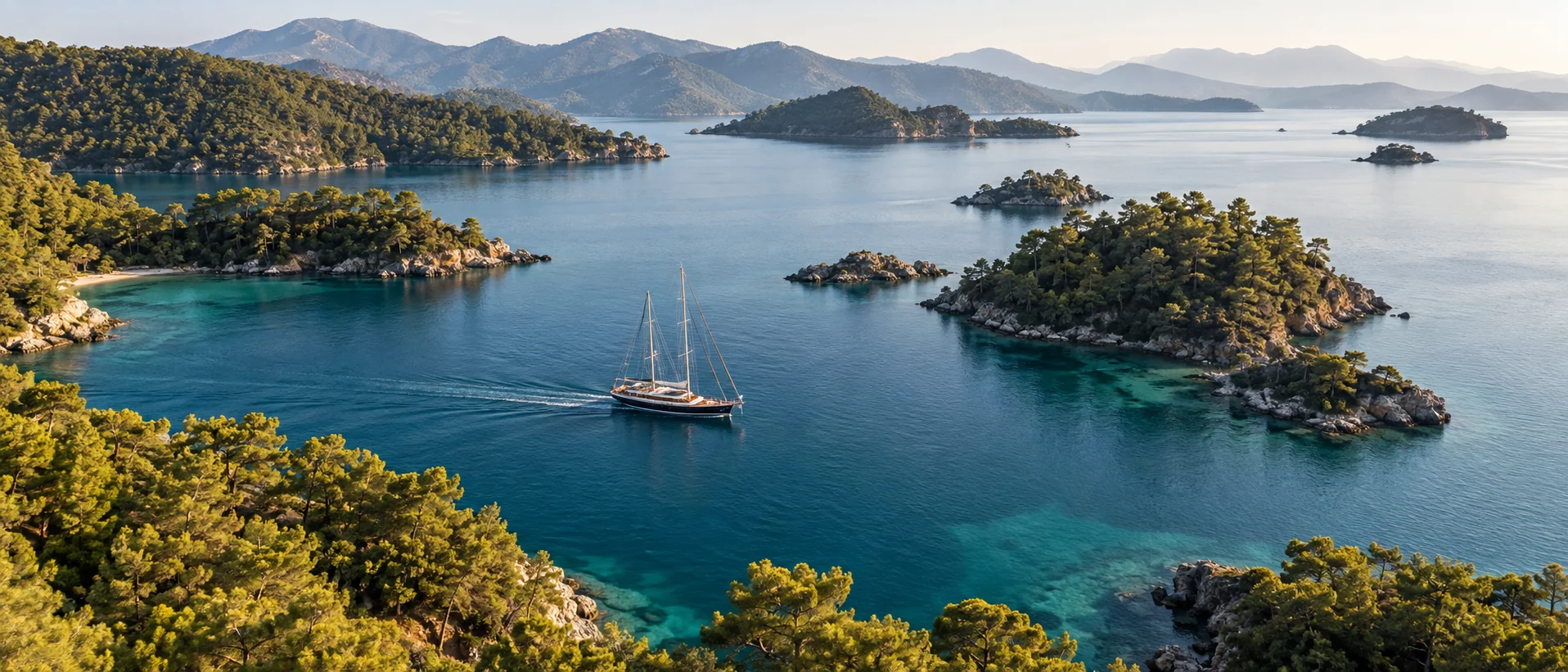
Göcek is the most concentrated cruising ground in the eastern Mediterranean, and the numbers make the case better than adjectives. Twenty-one kilometres from an international airport to a superyacht berth. Six marinas inside one bay. Twelve islands and something over fifty named anchorages, almost all of them inside protected water, most within an hour of each other under power.
You can charter here for a week and never once make a passage. That is the point. Where a Bodrum itinerary is built around legs, a Göcek itinerary is built around anchorages — which cove for lunch, which for the night, which restaurant to raft against. The sailing is incidental. The water is the destination.
It is also, from 2026, the most tightly regulated cruising ground in Türkiye, and any guide that skips that is useless to you. Section 4 covers the new mooring-buoy regime in full.
Distances are given in nautical miles and timed at two planning speeds: 8 knots for a gulet or Motor Sailer under power, 12 knots for a displacement motor yacht. In Göcek most legs are under an hour either way.
1. Arriving in Göcek
By air
Dalaman Airport (DLM) is 21 kilometres from Göcek — roughly 25 minutes by road. This is the shortest airport-to-marina transfer on the Turkish coast, and it is the single practical reason Göcek became what it is. A guest can land at 14:00 and be on a sunbed with a drink by 15:15.
The road runs through the Göcek Tunnel; the shuttle buses stop on the main road at the tunnel exit rather than in the village, which is why guests should always be met by car. Aquinox arranges greeting airside and door-to-passerelle delivery as part of our agency services.
For owners arriving privately, Dalaman handles general aviation with slot coordination and customs on request. Helicopter transfers to Göcek are straightforward and, in July and August traffic, occasionally worth it.
Other reference distances by road: Fethiye 25 km (30–35 min), Ölüdeniz 40 km (50 min), Marmaris 130 km (2 h), Kaş 130 km (2 h 15).
The six marinas
Göcek's density of berthing is unique in Türkiye, and choosing correctly matters more than guests realise.
D-Marin Göcek — the central marina on the village waterfront, with the promenade, the boutiques and the most social evening in town. The default for charter guests who want to walk off the passerelle into a restaurant.
Skopea Marina — Türkiye's first private marina, opened 1989, around 80 berths and mega-yacht capable. Central, boutique in scale, and quieter than D-Marin by design.
Club Marina — in Büngüş Bay just west of the village, established 1990, specialising in large yachts on moorings rather than pontoon berths. A natural sheltered bay with a restaurant and very little else, which is the appeal.
Marinturk Village Port — also in Büngüş, and the technical heart of the gulf: a 30,000 m² hardstanding with 200-tonne and 75-tonne travel lifts. Where the coast's refits happen.
Marinturk Exclusive — in Poruklu Bay, purpose-built for superyachts, with high-capacity docks, 250-amp shore power and controlled access.
Göcek Municipality Marina (Mucev) — the fuel station and the value option, central, with the market on the doorstep.
Aquinox holds berth allocations across the group and books them in advance; in high season the difference between a berth and a mooring in Göcek is a matter of weeks' notice, not days'.
2. Ashore: Göcek and What Lies Behind It
Göcek village itself is deliberately small — a single main street, a market, and a rule against high-rise building that has held. It is the anti-Bodrum, and clients either understand that immediately or should be chartering from somewhere else.
What Göcek offers ashore is what sits within an hour of it:
- Kayaköy (Levissi) — some 350 abandoned stone houses and two churches on a hillside above Fethiye, emptied by the 1923 population exchange and never reoccupied. A ticketed site, open daily 09:00–20:00. Go in the last hour of light.
- Xanthos and Letoon — the Lycian capital and its federal sanctuary, together inscribed on the UNESCO World Heritage list in 1988. Xanthos gave the British Museum the Nereid Monument; Letoon gave epigraphy the trilingual stele that cracked the Lycian language.
- Tlos — a Lycian acropolis with rock tombs, a stadium and an Ottoman fortress stacked on top, best combined with Saklıkent, an eighteen-kilometre slot canyon you wade into.
- Pınara — a remote Lycian city with a cliff face honeycombed with tombs. Rough access, almost no visitors, and the most atmospheric of the group.
- Babadağ — 1,960 metres, the world's best-known tandem paragliding mountain, now served by a cable car to 1,700 m with chairlifts above. Round trip 425 TL. Suspends in high wind.
- Ölüdeniz and the Blue Lagoon — the postcard. Motorised craft may not enter the lagoon; a yacht anchors outside off Belcekız and sends the tender. 2026 nature-park entry: 150 TL on foot, 800 TL by car.
- The Lycian rock tombs and the Tomb of Amyntas in Fethiye, cut into the cliff face above the town, open daily 09:00–20:00.
One correction worth having: Fethiye Museum has been closed for restoration for around two years with no announced reopening date. Do not build a shore day around it.
3. The Table: Göcek Dines on the Water
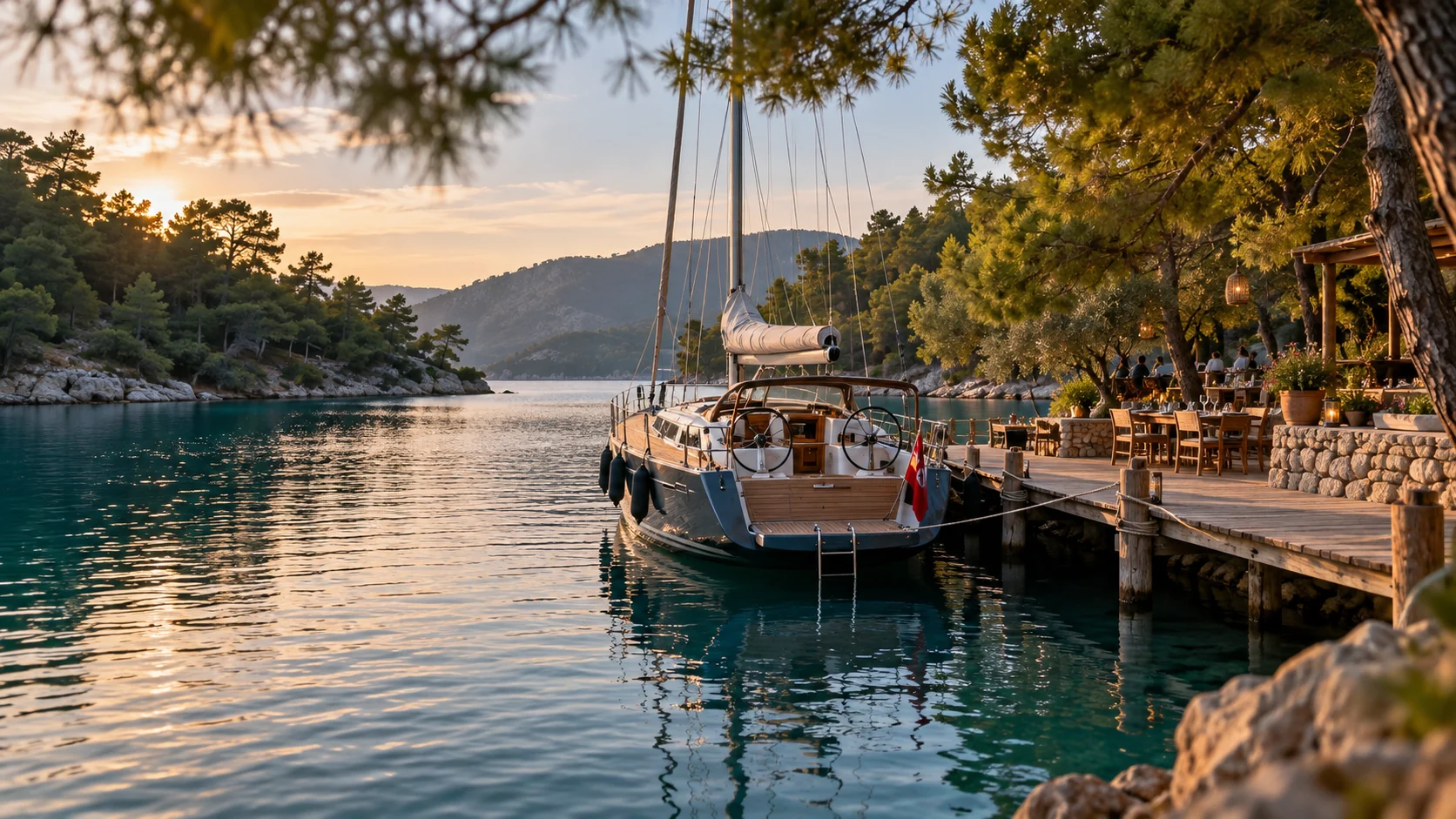
Göcek's restaurant culture is unlike anywhere else on this coast, because most of the good tables are not in the village. They are in coves, they have their own pontoons, and the mooring is free if you eat. This is the boat-in only register in its purest form, and it is the reason a Göcek charter feels different from a Bodrum one.
The convention: call ahead — several monitor VHF channel 08 — and a boatman will come out, take your lines and walk you onto the pontoon stern-to. You eat, you sleep on your own deck, you leave in the morning. Nobody sends a bill for the berth.
The cove tables
Onno Grill & Bar, Göcek Adası (Fimi Island) — MICHELIN Guide 2026, Selected. The most serious kitchen on the water in this gulf: Aegean and Mediterranean cooking, prime cuts and whole fish over wood, on an island with its own pier carrying power and water. Summer season only — it closes in winter. Book well ahead; this is the one table in Göcek that fills a month out.
Miori, Bedri Rahmi (Taşyaka) Bay — modern Mediterranean at the upper end. Scallop and octopus carpaccio, lobster linguine, slow-cooked lamb shank. Take the sunset seating; the bay faces the right way.
Adaia, Hamam Koyu (Cleopatra's Bath / Ruin Bay) — Mediterranean, with a beach, showers and proper facilities, which matters more than it sounds on day five. Seafood risotto, grilled octopus, a cold meze board. They sell local olive oil worth taking aboard.
Göbün Restaurant, Göbün Bay — family-run, in one of the most sheltered pockets in the gulf, and the most traditional of the group. Lamb tandır, whole baked grouper, shrimp casserole. Mooring assistance on VHF 08; reserve in advance.
Sarsala Restaurant, Küçük Sarsala — trading since 1993, with a private jetty for thirty-five boats. Fried calamari, whatever came in that morning, artichoke hearts in olive oil. Reachable by road as well as sea, which makes it the easy choice for a guest joining mid-charter.
There are further restaurant pontoons at Tersane Adası, Manastır Koyu (Wall Bay), Kapı Koyu (Kapı Creek), Boynuzbükü and Karacaören. Standards vary year to year — ask the captain, not the internet.
In the village
Q Lounge at D-Marin — Japanese-Peruvian Nikkei, sushi and black cod, the most international room in Göcek. Can Restaurant at Skopea Marina — Aegean fish done straight: grouper, red mullet, sea bass, Cretan ezme, samphire, prawns in butter. Dim Elit on the Kordon — modern Turkish seafood, octopus tandır. Özcan — the honest village fish house. Blues Restaurant & Bar on the Kordon for a late one, and Cafe West for the breakfast a crew change requires.
What to eat
The Muğla hinterland cooks differently from the coast, and it is worth ordering off the tourist register at least twice:
- Leğen böreği — a tray-sized pastry filled with wild herbs and local cheese.
- Çiriş otu and sılcan otu kavurması — wild asphodel and smilax shoots, sautéed in olive oil, served with yoghurt. Spring and early summer only.
- Ölemeç çorbası — a dough-piece soup with onion and red pepper, sometimes with meat.
- Et kapama — lamb slow-cooked over pilaf with the season's vegetables.
- Babadağ keşkeği — pounded wheat with lamb, finished with hot butter.
- Zeytinyağlı enginar — artichoke hearts in olive oil, the correct cold plate at a cove lunch.
- Çam balı — Muğla pine honey. The province produces the overwhelming majority of the world's supply. Dark, resinous, barely sweet; eat it with kaymak.
- Sığla (günlük) oil — the liquidambar resin distilled in this valley and almost nowhere else. Not food, but the most local thing you can take home.
4. The 2026 Mooring System: Read This Before You Charter
This is the most important operational change on the Turkish coast in a decade, and it applies to every vessel in the Göcek bays.
Anchoring is now prohibited inside the designated zones. Mooring on the buoys is mandatory.
What was installed
Around 926 seabed moorings and 906 buoys across 17 bays in the Fethiye–Göcek Special Environmental Protection Area, with simultaneous capacity for roughly 886 vessels. The system is operated by DERİA/ÇEYAŞ under the Turkish Environment Agency (TÜÇA), with a service fleet and around sixty staff. It was phased in from March 2026 and reached full operation in June.
Bays covered include Atbükü, Boynuzbükü, Kille (Killebükü), Bedri Rahmi (Taşyaka), Büyük and Küçük Sarsala, Martı, Ayten, Kurşunlu, Sıralıbük-Hurmalı and the Yassıca Adaları.
The rules that affect an itinerary
- Booking is digital — app or web, with QR verification at the buoy.
- Check-in 14:00, check-out 12:00. This is a hotel, not an anchorage.
- Maximum three consecutive nights in any one bay.
- Maximum eleven nights in total across all Göcek bays per season. For a yacht based here all summer, this is the constraint that shapes the whole programme.
- Free-anchoring zones are retained at Kuyrucak, most of Domuz Adası and Sıralıbük-Hurmalı.
Cost
Banded by length and by three seasonal periods (1 April–14 June, 15 June–31 August, 1 September–31 October). Indicatively: around USD 3.45 per day at 7 metres, USD 110 at 30 metres, USD 136 at 35 metres, USD 169 at 40 metres.
This is not included in charter rates. It is billed to the client. Any broker who does not tell you that in advance is setting up an argument at the end of the week — we put it in the proposal.
Separately: the Posidonia zones
There are standing anchoring-prohibited zones off Göcek for a Posidonia oceanica seagrass transplantation programme, defined by a KMZ file issued by the Göcek Harbour Master's Office. These are distinct from the buoy system and must be loaded into the plotter before the charter. Our captains carry them.
And the baseline compliance
Every vessel in Turkish waters needs digital waste tracking — the old paper Blue Card (Mavi Kart) has moved onto a national digital platform with vessel QR identity and centrally logged pump-outs. Black- and grey-water discharge is forbidden throughout the zone. A 6-knot speed limit applies inside the protected coves. Deck cooking over open flame, amplified music and diving are restricted in designated bays. The archaeological water at Hamam Koyu is off-limits to swimming and diving over the ruins.
A note on the fines. Turkish yachting sources have reported penalties in the region of TRY 699,000 for anchoring outside the permitted zones, tripled for commercial and charter operations. We have not been able to confirm that figure against the published tariff, and we do not quote it as fact. What is not in doubt is that the penalty is large enough that nobody sensible tests it. Verify with the port authority at the time of booking.
5. The Twelve Islands and the Coves of Skopea Limanı
Skopea Limanı is the sheltered water between Göcek and the western shore of the Gulf of Fethiye, and the Twelve Islands lie inside it. It is, in practical terms, a lake with a sea temperature — which is why families and nervous sailors are sent here.
The islands
Göcek Adası (Fimi) — one mile out, the closest island to the village, and the home of Onno.
Yassıca Adaları (the Flat Islands) — a cluster with a sandbar pool between them that is the single best day anchorage in the gulf. Shallow, turquoise, and by 11:00 in August, crowded. Go at eight or at five.
Tersane Adası (Shipyard Island) — the largest of the twelve, with the ruins of a Byzantine and Ottoman shipyard and an abandoned Greek village on the shore. The creek is rock-walled and holds laid moorings at the restaurant. The best all-round overnight in the group.
Domuz Adası (Prince Island) — privately owned, with coves on the north side. Largely excluded from the buoy field, so still free anchoring.
Zeytinli Ada, Hacı Halil, Kızıl Ada and the smaller rocks complete the count, depending on who is counting — the "twelve" is traditional rather than surveyed.
The coves that matter
Bedri Rahmi Koyu (Taşyaka / Tomb Bay) — named for the painter Bedri Rahmi Eyüboğlu, who painted a fish on a rock at the water's edge during a 1970s cruise; it has been retouched by admirers ever since. There is a Lycian rock tomb in the pines above the bay. Buoy field; Miori and Olive on the shore.
Tersane Adası — see above. Stern-to at the ruins.
Kapı Koyu (Kapı Creek) — a narrow inlet on the western shore with a restaurant at the head. Note for the captain: this bay is specifically known for strong westerly gusts in the afternoon.
Manastır Koyu (Wall Bay / Duvar Koyu) — a monastery wall runs down to the water; mud bottom, 5–20 m, two restaurant pontoons, very well sheltered.
Hamam Koyu (Ruin Bay / Cleopatra's Bath) — submerged Roman bath ruins at the head of the bay. Day stop; swimming and diving over the ruins are restricted, and the archaeological water is off-limits. Adaia is here.
Göbün Koyu — one of the most sheltered pockets in the gulf, with the family restaurant at the head.
Büyük and Küçük Sarsala — a long fjord-shaped inlet with good mud holding and the Sarsala jetty. Buoy field.
Boynuzbükü — mud in 5–15 m, a restaurant T-pier, a reef on the northern side to be given room. Buoy field.
Kille (Killebükü), Atbükü, Kurşunlu, Ayten, Martı — the remaining buoy bays, all quieter than the famous names and worth taking on a busy week.
Kuyrucak and Sıralıbük-Hurmalı — free-anchoring zones. Increasingly valuable for that reason alone.
Outside the gulf, within a day
Gemiler Adası (St Nicholas Island) — a Byzantine church complex with a covered processional way climbing the ridge, from the fifth and sixth centuries. The channel between the island and the mainland is the best storm shelter on this stretch of coast. Overnight.
Karacaören Adası — mooring buoys, a restaurant, and free anchoring outside the field. Overnight.
Soğuksu Limanı — "Cold Water Bay", named for the freshwater springs that come up through the seabed. Pre-set shore lines. Overnight.
Ölüdeniz / Belcekız — anchor outside the lagoon only. Day stop, untenable in any southerly swell.
Kelebekler Vadisi (Butterfly Valley) — a first-degree protected natural site, home to the Jersey tiger moth, with a fifty-metre waterfall at the head of the gorge. Steep-to and deep: day stop only, no overnight. Tender landing on the beach; 250 TL per person entry from the sea in 2026. There is no safe descent from the road above, whatever the guidebooks say.
6. Five Route Alternatives
Route One — The Twelve Islands · 4 nights · ~30 NM
The definitive Göcek week in miniature, and the answer for guests with four days and no interest in passage-making. Almost no leg exceeds forty minutes.
| Day | Leg | NM | 8 kn | 12 kn | Night |
|---|---|---|---|---|---|
| 1 | D-Marin Göcek → Göcek Adası (lunch) → Yassıca Adaları | 1 + 2 | 0h25 | 0h15 | Yassıca (buoy) |
| 2 | Yassıca → Bedri Rahmi Koyu | 3 | 0h25 | 0h15 | Bedri Rahmi (buoy) |
| 3 | Bedri Rahmi → Hamam Koyu (lunch) → Tersane Adası | 2 + 3 | 0h40 | 0h25 | Tersane (stern-to) |
| 4 | Tersane → Kapı Koyu (lunch) → Göbün | 2 + 4 | 0h45 | 0h30 | Göbün (jetty) |
| 5 | Göbün → Domuz Adası (swim) → Göcek | 3 + 3 | 0h45 | 0h30 | Disembark |
How it runs. Board at D-Marin in the afternoon and go no further than Göcek Adası for the first evening — dinner at Onno, booked before the charter was signed, with the tender running two minutes each way. It sets the register for the week.
Day two is a swimming day at Yassıca, on the sandbar, ideally before ten. Move to Bedri Rahmi in the afternoon; walk up to the Lycian tomb in the pines before dinner and take the sunset seating at Miori.
Day three: Hamam Koyu for the morning, over the Roman bath ruins — from the deck and the tender, not with a mask over the archaeology — then round to Tersane for the night. Walk the Byzantine shipyard and the abandoned village at dusk when the day boats have gone. It is the best hour of the itinerary.
Day four is the local one: lunch at Kapı Creek (watch the afternoon westerly), then the short hop to Göbün for lamb tandır at the family jetty.
Day five, a swim off Domuz Adası — free anchoring, no buoy booking — and in by noon.
Buoy planning note. Three of the four nights above are in buoy bays. That is three of your eleven seasonal nights used. Book them the moment the charter is confirmed.
Route Two — Göcek, Fethiye and the Lycian Shore · 7 nights · ~70 NM
The full week, and the one that shows guests something beyond the gulf. It commits to two open-coast legs, which is why they are both scheduled for the morning.
| Day | Leg | NM | 8 kn | 12 kn | Night |
|---|---|---|---|---|---|
| 1 | Göcek → Boynuzbükü | 3 | 0h25 | 0h15 | Boynuzbükü (buoy) |
| 2 | Boynuzbükü → Yassıca (swim) → Tersane Adası | 2 + 4 | 0h45 | 0h30 | Tersane |
| 3 | Tersane → Bedri Rahmi | 3 | 0h25 | 0h15 | Bedri Rahmi (buoy) |
| 4 | Bedri Rahmi → Fethiye (Ece Marina) | 8 | 1h00 | 0h40 | Fethiye (berth) |
| 5 | Fethiye → Gemiler Adası | 8 | 1h00 | 0h40 | Gemiler |
| 6 | Gemiler → Ölüdeniz (day) → Kelebekler Vadisi (day) → Soğuksu | 4 + 3 + 6 | 1h40 | 1h05 | Soğuksu |
| 7 | Soğuksu → Karacaören (lunch) → Domuz Adası | 3 + 10 | 1h40 | 1h05 | Domuz Adası |
| 8 | Domuz Adası → Göcek | 4 | 0h30 | 0h20 | Disembark |
Day four is a deliberate change of gear. Fethiye is a working town with a proper fish market, and the market is the point: you buy the fish at a stall, haggle by the kilo, watch it cleaned, carry it to any of the restaurants encircling the hall, and they cook it for a fixed cover while you order meze around it. It is the best-value serious meal on this coast and guests remember it more than the starred rooms. Berth at Ece Marina — 400 berths, 60 m maximum, pump-out, and a port of entry — and walk into the old town at Paspatur afterwards.
Day six is the one to run properly. Leave Gemiler at eight. Take Ölüdeniz in the late morning, anchoring off Belcekız outside the lagoon — motorised craft may not enter — and send the tender in. Then Butterfly Valley for the early afternoon: tender landing, the 250 TL fee, and the walk up the gorge to the waterfall. Be off that coast by four. The Babadağ massif behind Ölüdeniz funnels hard down-gusts into this shore in the late afternoon and again as a night katabatic, and there is no shelter there worth the name. Run back to Soğuksu and its cold springs for the night.
Route Three — Göcek to Marmaris via Ekincik and Dalyan · 7 nights · ~90 NM · one-way
For guests continuing west, and for anyone who wants the single best shore excursion on this coast.
Göcek → Yassıca → Tersane Adası → Kapı Koyu → Ekincik → (Dalyan and Kaunos by river boat) → Gerbekse → Çiftlik → Kumlubükü → Marmaris (Netsel).
The reason to go is Ekincik, and the reason to stop at Ekincik is Dalyan. Yachts do not enter the river — the sandbar and the shoal water make it a local-boat job — so the drill is to anchor at Ekincik and take a river boat up the delta: past the Lycian rock tombs of Kaunos cut into the cliff face above the reed beds, through the channels to Kaunos itself, and out to İztuzu, the loggerhead turtle nesting beach at the river mouth. Allow the whole day. Ekincik itself has good shelter from strong southerlies and a yacht club jetty.
From there the coast turns hard and open — Gerbekse with its Byzantine chapels is a settled-weather stop only — before the softer run into Kumlubükü and Marmaris. Full detail in the Marmaris guide.
Route Four — Göcek to Kaş and Kekova · 10 nights · ~130 NM · one-way
The serious itinerary, and the one to propose to a client who has already done the Twelve Islands twice.
Göcek → Bedri Rahmi → Gemiler Adası → Ölüdeniz → Kabak → Kalkan → Kaputaş → Kaş → Üçağız → Kekova Roads → Gökkaya.
The character changes completely past Ölüdeniz. The Lycian coast is steep-to and tectonically drowned: the bottom falls away to more than forty metres just off the rocks, there is almost no five-to-ten-metre shelf, and the technique everywhere is to anchor deep and run two long lines ashore to rock and tree. Fifty to eighty metres of warp is normal. Guests used to Göcek's mud find it alarming for the first two days and then prefer it.
The payoff is Kekova: the Byzantine and Lycian city that subsided into the sea after the earthquakes of the second century AD, with quays, stairs and house walls half-drowned along the island's northern shore. Swimming, diving and anchoring over the sunken city are prohibited — you transit and look. Then Simena castle above the smallest theatre in Lycia, in a village with no cars, where the restaurants are supplied by boat. Full detail in the Kaş guide.
The Long Weekend · 2 nights · ~15 NM
Göcek → Göcek Adası (dinner at Onno) → Yassıca (swim) → Tersane Adası (night two) → Domuz Adası → Göcek. Fifteen miles, two of the best anchorages in the gulf, one of the best tables, and the guest is back at Dalaman in half an hour.
7. Season, Wind and Timing
Göcek sits at the far south-eastern end of the meltem's reach, and the practical consequence is that it is markedly gentler here than in the Aegean. A typical summer day: a calm morning with a light south-easterly to about ten knots; a midday southerly to south-westerly at four to eight; an afternoon sea breeze from the south-west and west at eight to twelve, gusting eighteen, with a short chop in the open gulf; then a drop at dusk to a light northerly overnight. Outside the gulf, north-westerlies of fifteen to twenty knots are the season norm. There is no significant tide or current.
Two local effects matter. The Babadağ massif at 1,960 metres funnels violent down-gusts into the Ölüdeniz and Kabak shore in the late afternoon and again at night. And Kapı Creek is specifically known for strong westerly gusts. Neither is a hazard to a competent crew; both are reasons to plan open-coast legs for the morning.
Sea temperatures: May 20°C, June 24°C, July 27°C, August 28°C (peak), September 27°C, October 24°C. The water here holds its heat later than the Aegean.
- May and early June — the connoisseur's window. Warm enough, uncrowded, and every buoy available.
- Late June to mid-July — the strongest all-round conditions.
- Late July and August — the peak. Book buoys and marina berths months ahead; Yassıca is full by eleven.
- September — the best month on this coast, and the one professionals choose.
- October — quiet, still swimmable, and the buoy system's last month of operation before the 31 October season close.
8. Chartering from Göcek with Aquinox
Aquinox Yachting is a TÜRSAB-certified brokerage and charter house operating across the Turkish Riviera, with full agency capability through our partnership with UCT Agency: berthing across all six Göcek marinas, mooring-buoy reservations, port clearance, transit logs, duty-free bunkering, provisioning, crew placement and refit management at the Marinturk yard.
We do not publish vessel names. Our fleet is presented by specification and code, and the right yacht is proposed after we understand the party. In Göcek that decision turns on something specific: a gulet or Motor Sailer is the correct answer for a family working through the Twelve Islands, where deck space is worth more than speed, while a motor yacht earns its keep only on the one-way routes east and west.
Request a Göcek charter proposal — or read the series from the beginning with our Bodrum route guide.
FAQ
Frequently Asked Questions
Do I have to use the mooring buoys in Göcek?
Yes. Since 2026, anchoring is prohibited inside the designated zones across seventeen bays in the Fethiye–Göcek protected area, and buoy use is mandatory. Booking is digital with QR verification at the buoy. Free anchoring is retained at Kuyrucak, most of Domuz Adası and Sıralıbük-Hurmalı.
How much do the Göcek mooring buoys cost?
Banded by length and season — indicatively around USD 3.45 per day for a 7-metre boat rising to about USD 169 per day at 40 metres. It is billed to the client and is not included in charter rates. Confirm the current tariff at booking; it moved during the system's first year.
How many nights can I stay in one bay?
Three consecutive nights maximum in any single bay, and eleven nights in total across all Göcek bays per season. Check-in is 14:00 and check-out 12:00.
How far is Göcek from Dalaman Airport?
Twenty-one kilometres, about twenty-five minutes by road — the shortest airport-to-marina transfer on the Turkish coast.
Göcek or Bodrum for a first charter?
Göcek, almost always. The anchorages are close together, the water is protected, the legs are short, and nobody gets seasick. Bodrum and the Gulf of Gökova ask more of the guests and give more back on the second or third charter.
Which Göcek restaurants can only be reached by boat?
Onno on Göcek Adası is the flagship — MICHELIN Guide Selected, with its own pier. Miori at Bedri Rahmi, Adaia at Hamam Koyu, Göbün, and the pontoons at Tersane, Kapı Creek, Wall Bay and Boynuzbükü all take yachts alongside, generally without a berthing charge if you dine. Several monitor VHF channel 08.
Can I visit Butterfly Valley by yacht?
You can land by tender for the day — the entry fee from the sea is 250 TL per person — but you cannot stay overnight. The bay is steep-to, deep and completely exposed, and the coast gusts hard in the late afternoon.
What does a Göcek charter cost?
It depends on vessel, season and party size, and any figure quoted without those is fiction. Note that the mooring-buoy fees sit outside the charter rate. We build proposals against the itinerary. Ask us.


 English
 Turkish