
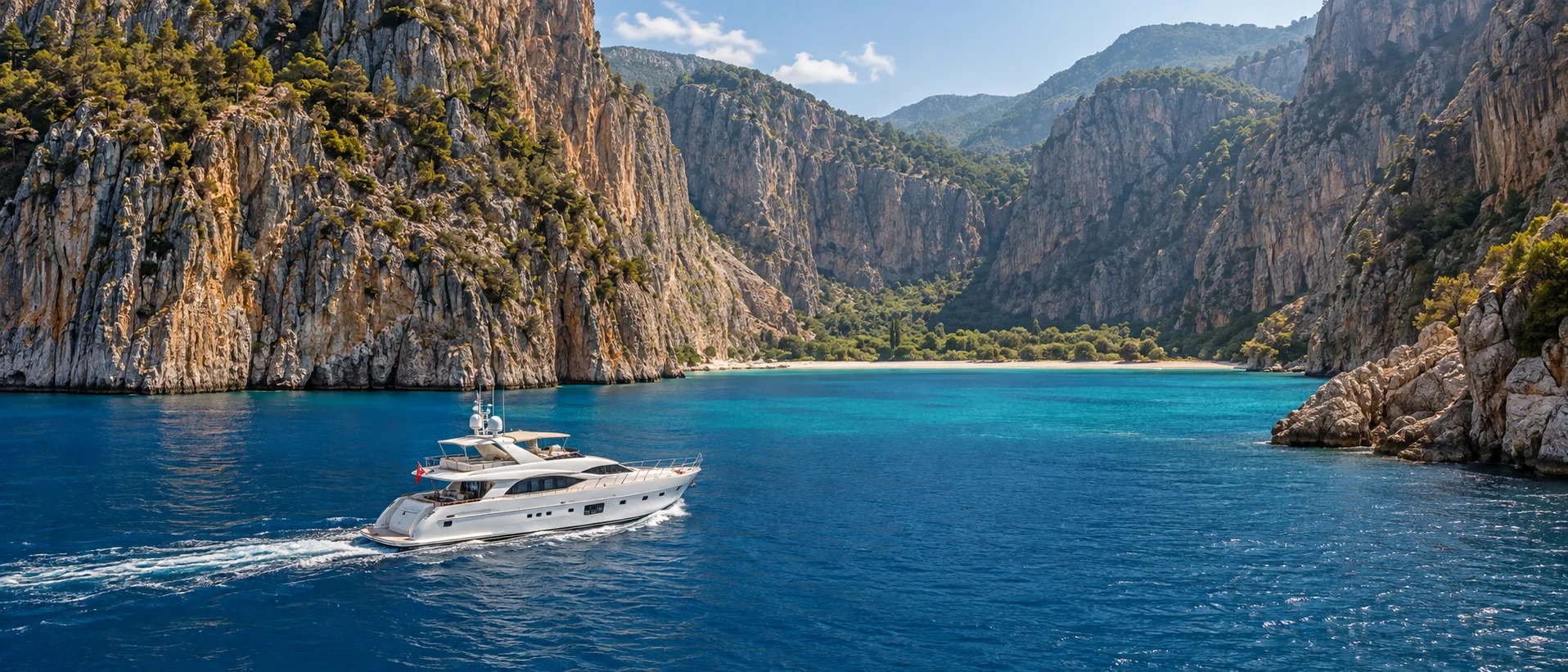
Fethiye is the working town of this coast, and that is the whole argument for chartering from it.
Where Göcek is a marina village built around yachts, Fethiye is a city of eighty thousand people that happens to have one of the finest natural harbours in the Mediterranean at the foot of it. There is a fish market where you buy your own dinner. There are Lycian tombs cut into the cliff directly above the quay. There is a Roman theatre a hundred and fifty metres from where you tie up. And there is a coastline running south from the harbour mouth that Göcek's protected water cannot offer at all — open, cliff-bound, Byzantine, and considerably more interesting.
A Fethiye charter is therefore two itineraries in one hull: the sheltered inner gulf, which is family cruising of the gentlest kind, and the Lycian shore beyond Kızılada, which is real coastal sailing. This guide covers both.
Distances are in nautical miles, timed at 8 knots for a gulet or Motor Sailer under power and 12 knots for a displacement motor yacht.
1. Arriving in Fethiye
By air and road
Dalaman Airport (DLM) is 45 km from Fethiye centre — roughly 45 to 50 minutes, and closer to seventy in August. Add five minutes for Ece Marina on the south-western shore.
Other reference distances: Göcek 25 km (30–35 min, or 12 NM by sea), Ölüdeniz 14 km (25–30 min), Saklıkent 45 km, Kaş 110 km (about 2 hours on the D400 corniche).
Antalya (200 km, 3–3.5 h) and Milas–Bodrum (250 km, 3.5 h) exist but are not charter airports for this coast. Dalaman is the only sensible answer.
There is a high-speed catamaran from Rhodes, roughly one hour forty-five to two hours, docking at the commercial harbour. Fethiye is a designated port of entry, which matters for anyone arriving on their own keel.
Marinas and berthing
Ece Saray Marina (Ece Marina) — the principal berth, on the south-western shore at 1. Karagözler. Around 400 berths, maximum LOA 60 metres, depths of two to five metres, black- and grey-water pump-out, fuel dock, laundry, 24-hour security, pilot-boat assistance, and full port of entry status. A five-star resort is attached, which solves the pre- and post-charter night.
Yacht Classic Hotel Marina — boutique, around thirty berths in the inner harbour, with the hotel and the Mori restaurant on site.
Yes Marina — about a mile west of the town harbour, roughly thirty yachts to a maximum 25 metres, three to five metres depth, with showers, laundry, a market and a restaurant.
Fethiye Municipality Marina / town quay — anchor-and-stern-to with water, power, showers, fuel and Wi-Fi. Functional, inexpensive, and in practice oriented to the local fleet.
A planning note that matters. Vessels over about sixty metres do not berth in Fethiye. They go to Göcek — D-Marin, Skopea, Club Marina or Marinturk Exclusive — twelve miles west, and guests transfer by road or tender. Any proposal that puts an eighty-metre yacht on the Fethiye quay has not been checked.
2. Ashore: Lycia Begins Here
Fethiye is ancient Telmessos, and unusually for this coast the ancient city is not somewhere you drive to — it is underneath the modern one.
The Tomb of Amyntas and the Lycian rock tombs — a fourth-century BC temple façade carved directly into the cliff above the town, with a scatter of smaller house tombs around it. Open daily 09:00–20:00, last ticket 19:30. Fifteen minutes and a flight of steps from the harbour, and worth timing for the last hour of light.
The Telmessos theatre — Roman, around six thousand seats, a hundred and fifty metres from the quay. Restored and reopened in 2022 for performances. Free.
Fethiye Castle — a hilltop Crusader fortress above Karagözler, associated with the Knights of Rhodes. Unfenced, free, steep.
Kayaköy (Levissi) — roughly 350 abandoned stone houses and two churches on the hillside eight kilometres south, emptied by the 1923 population exchange and never reoccupied. A ticketed site, open daily 09:00–20:00. It is the most affecting hour on this coast and should not be rushed.
Ölüdeniz and the Blue Lagoon — inside a national nature park. 2026 entry: 150 TL on foot, 800 TL by car, 450 TL by motorbike; sunbeds at Kumburnu run to around 1,500 TL for two with an umbrella. Motorised craft are banned inside the lagoon — a yacht anchors outside off Belcekız and sends the tender.
Babadağ — 1,960 metres, the tandem paragliding mountain, with a gondola to 1,700 m and chairlifts to 1,800 m and the summit. Round trip 425 TL. Suspends in high wind, which in August is not unusual.
Saklıkent Gorge — an eighteen-kilometre slot canyon in a national park, forty-five kilometres east. Snowmelt makes it impassable and painfully cold in spring; grip shoes are rentable at the entrance and genuinely necessary.
Tlos — a Lycian acropolis with rock tombs, a stadium and an Ottoman fortress stacked on the summit, best paired with Saklıkent on one land day.
Pınara — a remote Lycian city whose cliff face is honeycombed with tombs. The access track is rough and there are almost no visitors, which is precisely the recommendation.
Xanthos and Letoon — the Lycian capital and its federal sanctuary of Leto, Apollo and Artemis, together inscribed on the UNESCO World Heritage list in 1988. Xanthos gave the British Museum the Nereid Monument and the Harpy Tomb; Letoon gave scholarship the trilingual stele that unlocked the Lycian language. Letoon is open daily 09:00–20:00, at kilometre 65 of the Fethiye–Kaş road.
Çalış — four kilometres of sand and shingle north of town, facing the sunset, with a water taxi to the harbour. Free, shallow and popular with windsurfers.
Do not put Fethiye Museum on an itinerary. It has been closed for restoration for around two years with no announced reopening date, which is a pity — it holds the Letoon trilingual stele of 338 BC.
3. The Table: The Fish Market Is the Main Event
Fethiye has good restaurants. It also has something better, and any guide that leads with the restaurants has the order wrong.
The Balık Pazarı
The fish market is a ring of fishmongers around a central hall, with restaurants encircling the whole thing. The system, for anyone who has not done it:
- Walk the stalls and choose your fish by eye. Sea bass, bream, red mullet, calamari, prawns, whatever came in.
- Agree a price by the kilo. Haggling is expected and not adversarial.
- The stall cleans and guts it in front of you.
- Carry it to any of the surrounding restaurants. They weigh it, agree a fixed per-head cover for cooking it — grilled, fried or baked — and you order meze, salad, bread and drinks from them.
It is the best-value serious meal on this coast, it takes about two hours, and charter guests describe it more often than they describe the starred rooms in Yalıkavak. Reis Restaurant, inside the market, is one of the fastest and busiest of the cook-houses. Go in the evening when the whole square is working.
Destination kitchens
Ada Restaurant, Şövalye Adası — MICHELIN Guide Selected. On an island in the bay, reached by a free ten-minute ferry from Karagözler or, better, by your own tender. Turkish and Mediterranean: grilled sea bass with spiced roast potatoes, wood-oven smoked aubergine with yoghurt, lamb tandır.
Mori, at the Yacht Classic Hotel — Fethiye's first entry into the MICHELIN Guide. Mediterranean and Italian; linguine in a light velouté, squid, pink prawns.
Cafe Park Teras — a roof terrace on the harbourfront with a lift, the best view in town, and modern Turkish cooking. Open year-round, closed Mondays in summer.
The local register
Meğri Lokantası, in the Paspatur old town — the town institution for esnaf-style home cooking and meze, with a large terrace. If a client asks for "somewhere real", this is the answer.
Mozaik Bahçe, on a side street between the fish market and the PTT — a garden setting, Turkish cooking, seasonal from March to November.
The harbour kordon carries a run of conventional fish-and-rakı houses. They are fine. The market is better.
Boat-in dining
The cove restaurants of this gulf are concentrated on the Göcek side and are covered in full in that guide — Onno on Göcek Adası, Miori at Bedri Rahmi, Adaia at Hamam Koyu, Göbün, Sarsala and the pontoons at Tersane, Kapı Creek and Wall Bay. Several monitor VHF channel 08. On the Fethiye side proper, Boynuzbükü has a restaurant T-pier and Karacaören has buoys and a restaurant on the southern run.
What to eat
The Muğla hinterland cooks differently from the coast:
- Leğen böreği — a tray-sized pastry of wild herbs and local cheese.
- Çiriş otu and sılcan otu kavurması — wild asphodel and smilax shoots in olive oil, with yoghurt. Spring and early summer.
- Ölemeç çorbası — a dough-piece soup with onion and red pepper.
- Et kapama — lamb slow-cooked over pilaf with seasonal vegetables.
- Babadağ keşkeği — pounded wheat with lamb under hot butter.
- Yumurta bohçası — poached eggs in garlic yoghurt under paprika butter. A breakfast worth staying aboard for.
- Çam balı — Muğla pine honey. Sığla (günlük) oil — liquidambar resin distilled in these valleys and almost nowhere else on earth.
4. Bays and Anchorages
Fethiye's cruising divides in two at Kızılada, the lighthouse island at the mouth of the bay. Inside is sheltered water; outside is the Lycian coast.
The inner gulf
Şövalye Adası (~1.5 NM) — the island off Karagözler. Anchor on the north or east side over sand and weed. Day stop, and overnight in settled weather. Ada Restaurant's jetty is here.
Kızılada (~3 NM) — the lighthouse at the bay mouth. Day stop; no shelter in a westerly.
Samanlık Koyu (~4 NM) — pine-backed on the southern shore, sheltered from the north. Overnight in settled conditions.
Akvaryum Koyu (~5 NM) — clear shallow water, the snorkelling stop of the inner bay. Exposed to the afternoon westerly; day only.
Boncuklu and Küçük Boncuklu (~5 NM) — a pebble beach with good holding and proper shelter. One of the better overnights close to town.
Merdivenli Koyu (~7 NM) — steep-to, long line ashore, quiet. Overnight.
Katrancı and Günlüklü (~8–9 NM) — road-accessible day parks on the north shore, open to the south, day stop only. Günlüklü takes its name from the liquidambar grove behind the beach.
Boynuzbükü (~10 NM) — mud in five to fifteen metres, a restaurant T-pier, a reef on the northern side to be given room, and a long line ashore. A good overnight, and now inside the Göcek buoy field.
Regulatory crossover. The bays on the Göcek side of this gulf — Boynuzbükü, Bedri Rahmi, Sarsala, Kille, Yassıca and the rest — fall under the 2026 mandatory mooring-buoy regime, where anchoring is prohibited and buoys must be booked digitally, with a three-night cap per bay and eleven nights per season. The Fethiye-side coves listed above (Boncuklu, Samanlık, Merdivenli, Akvaryum) are not in the named buoy list and are treated as free-anchoring, but this should be confirmed with the harbour master at the time of booking — the scheme is expanding. Full detail in the Göcek guide.
The Lycian shore, south of Kızılada
This is the half of Fethiye that Göcek cannot offer.
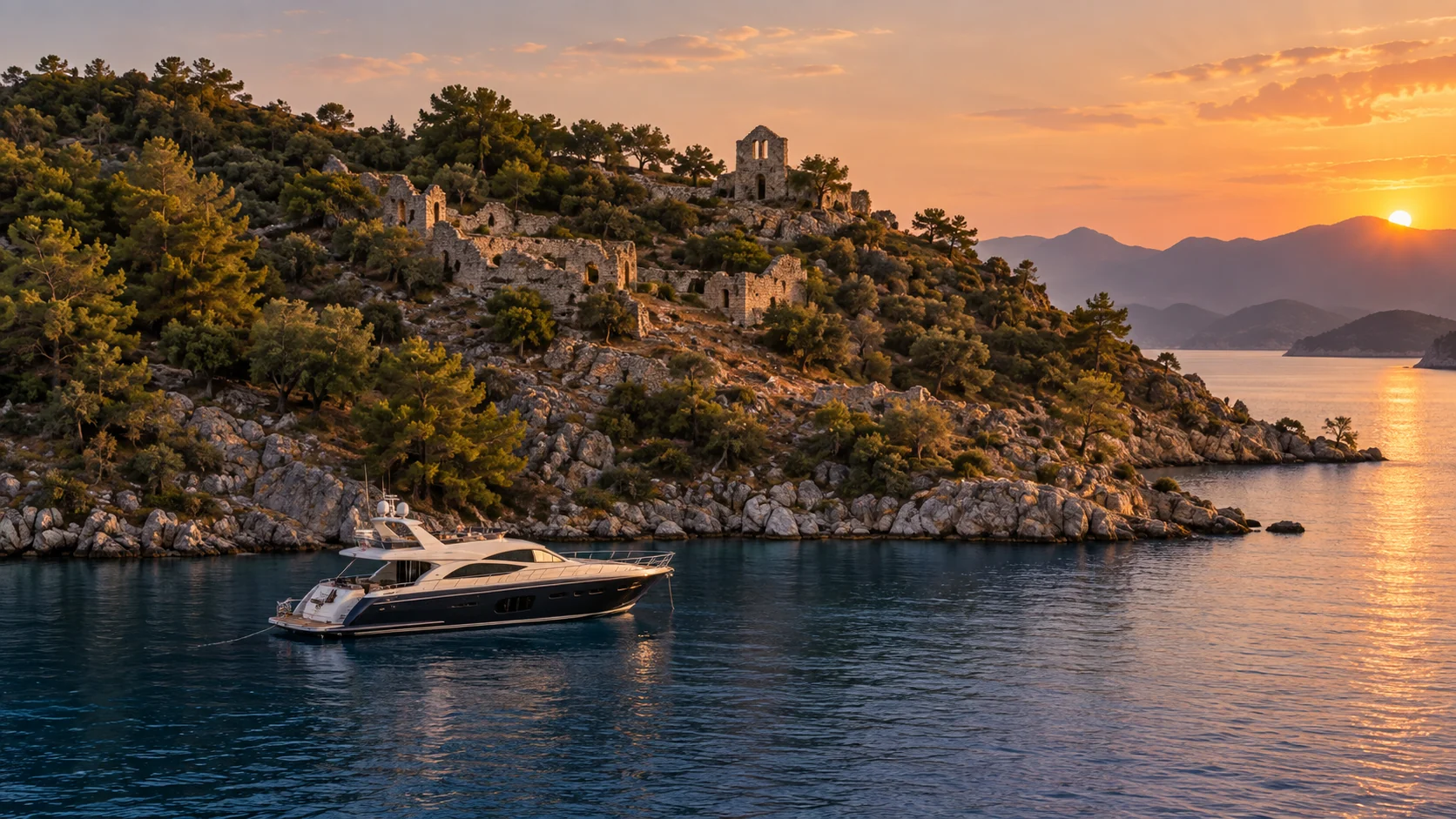
Gemiler Adası (St Nicholas Island) (~12 NM) — a Byzantine church complex of the fifth and sixth centuries, with a covered processional way climbing the ridge from the shore to the summit church. The channel between the island and the mainland is the best storm shelter on this stretch of coast. Overnight, and one of the two or three anchorages on the Turkish coast worth planning a whole charter around.
Karacaören Adası (~13 NM) — mooring buoys and a restaurant, with free anchoring outside the field. Overnight.
Soğuksu Limanı (~13 NM) — "Cold Water Bay", named for the freshwater springs rising through the seabed. Pre-set shore lines. Overnight.
Ölüdeniz / Belcekız (~15 NM) — anchor outside the lagoon off Belcekız only. Day stop, and untenable in any southerly swell.
Kelebekler Vadisi (Butterfly Valley) (~17 NM) — a first-degree protected natural site, home to the Jersey tiger moth, with a fifty-metre waterfall at the head of the gorge. Steep-to and deep. Day stop only — no overnight. Tender landing on the beach; 250 TL per person entry from the sea in 2026. Shuttle boats run from Ölüdeniz at 11:00, 14:00 and 18:00. There is no safe descent from the Faralya road above, whatever you are told.
Kabak Koyu (~20 NM) — remote, deep and open to the west. A fair-weather day stop and nothing more.
The Babadağ effect. The 1,960-metre massif behind Ölüdeniz funnels violent down-gusts into this shore in the late afternoon, and again as a night katabatic. There is no shelter worth the name between Gemiler and Kabak. Run this coast in the morning and be back behind Gemiler or Soğuksu by four. This is the single most useful sentence in the guide.
5. Four Route Alternatives
Route One — The Lycian Shore · 7 nights · ~75 NM
The route that justifies chartering from Fethiye rather than Göcek.
| Day | Leg | NM | 8 kn | 12 kn | Night |
|---|---|---|---|---|---|
| 1 | Ece Marina → Şövalye Adası | 1.5 | 0h15 | 0h10 | Şövalye |
| 2 | Şövalye → Akvaryum (swim) → Boncuklu | 4 + 2 | 0h45 | 0h30 | Boncuklu |
| 3 | Boncuklu → Gemiler Adası | 8 | 1h00 | 0h40 | Gemiler |
| 4 | Gemiler → Ölüdeniz (day) → Kelebekler Vadisi (day) → Soğuksu | 4 + 3 + 6 | 1h40 | 1h05 | Soğuksu |
| 5 | Soğuksu → Karacaören | 3 | 0h25 | 0h15 | Karacaören |
| 6 | Karacaören → Tersane Adası (Göcek) | 12 | 1h30 | 1h00 | Tersane |
| 7 | Tersane → Yassıca (swim) → Boynuzbükü | 4 + 3 | 0h55 | 0h35 | Boynuzbükü (buoy) |
| 8 | Boynuzbükü → Fethiye | 10 | 1h15 | 0h50 | Disembark |
Night one is deliberate. Board at Ece, run fifteen minutes to Şövalye, and eat at Ada Restaurant — Michelin-listed, on an island, ten minutes from the marina. It resets the guests' expectations of what the week is going to be.
Day three is the day the charter turns. Leave the inner bay, round Kızılada, and the character changes: cliffs, open water, no road. Anchor in the channel at Gemiler in the afternoon and walk the processional way before the light goes. It is a covered stone corridor climbing the spine of an island to a fifth-century church, built for pilgrims, and it is empty at seven in the evening.
Day four is the day to run properly. Off the mooring by eight. Ölüdeniz in the late morning — anchor off Belcekız, tender into the lagoon, which no motorised craft may enter. Butterfly Valley in the early afternoon: land by tender, pay the 250 TL, walk the gorge to the waterfall. Be off that coast by four, ahead of the Babadağ gusts, and into Soğuksu for the night.
Days six and seven cross into Göcek's water for the contrast — Tersane for the Byzantine shipyard, Yassıca for the sandbar — and one buoy night at Boynuzbükü to close.
Route Two — The Inner Gulf · 4 nights · ~35 NM
For families, first-timers and anyone who does not want a passage. Nothing exceeds an hour.
Fethiye → Şövalye Adası → Boncuklu Koyu → Merdivenli → Katrancı (lunch) → Boynuzbükü → Fethiye.
Swim off Şövalye, lunch at Akvaryum, dinner ashore at Ada. A night at Boncuklu on the pebbles. A quiet night at Merdivenli with a line ashore and nobody else in the cove. Lunch at Katrancı where the road comes down. A buoy night at Boynuzbükü with dinner at the T-pier. Home by noon.
The one thing to add: one evening in the fish market, before or after. It is the memory the guests take home, and it costs a fraction of everything else on the itinerary.
Route Three — Fethiye to Kaş and Kekova · 10 nights · ~110 NM · one-way
The serious itinerary east, and the natural progression for a returning client.
Fethiye → Gemiler Adası → Ölüdeniz → Kabak → Kalkan → Kaputaş → Kaş → Üçağız → Kekova Roads → Gökkaya.
The coast changes completely past Kabak. Lycia here is steep-to and tectonically drowned: the bottom falls to more than forty metres just off the rocks, there is almost no shallow shelf, and the universal technique is to anchor deep and run two long lines ashore — fifty to eighty metres of warp is routine. Guests used to the gulf's mud find it alarming for two days and then prefer it.
The payoff is Kekova, where a Byzantine and Lycian town subsided into the sea after the earthquakes of the second century AD. Quays, stairs and house walls lie half-drowned along the island's northern shore. Swimming, diving and anchoring over the sunken city are prohibited — you transit and you look, and the rule exists for good reason. Then Simena, a car-free village under a Crusader castle, above the smallest theatre in Lycia. Full detail in the Kaş guide.
Note the direction. This is a one-way charter; the yacht returns light or the next party joins in Kaş. Price it accordingly.
Route Four — Fethiye to Marmaris via Ekincik · 7 nights · ~95 NM · one-way
West rather than east, and built around the best shore excursion on the Turkish coast.
Fethiye → Boynuzbükü → Tersane Adası → Kapı Koyu → Ekincik → (Dalyan and Kaunos by river boat) → Gerbekse → Çiftlik → Marmaris.
Yachts do not enter the Dalyan delta — the sandbar and shoal water make it a local-boat job. Anchor at Ekincik and take a river boat up through the reed channels, past the Lycian rock tombs of Kaunos cut into the cliff, to the ancient city itself and out to İztuzu, the loggerhead nesting beach at the river mouth. Give it the whole day. Full detail in the Marmaris guide.
6. Season, Wind and Timing
Fethiye sits at the far south-eastern limit of the meltem's reach, which makes it markedly gentler than the Aegean. The typical summer day: a calm morning with a light south-easterly to about ten knots; a midday southerly to south-westerly at four to eight; an afternoon sea breeze from the south-west and west at eight to twelve, gusting eighteen, with three-quarters of a metre to a metre and a half of chop in the open gulf; then a drop at dusk to a light northerly overnight. Outside the gulf, north-westerlies of fifteen to twenty are the norm. No significant tide or current.
The local effect that governs the itinerary is Babadağ, as above: hard down-gusts onto the Ölüdeniz and Kabak shore in the late afternoon and again at night. Open-coast legs go in the morning. Always.
Sea temperatures: May 20.3°C, June 23.9°C, July 26.9°C, August 28.2°C (peak), September 27.2°C, October 24.1°C. The water holds its heat noticeably later here than in Bodrum.
- May and early June — warm enough, green ashore, uncrowded. The connoisseur's window.
- Late June to mid-July — the strongest all-round conditions.
- Late July and August — hottest and most congested; the paragliders are grounded as often as not.
- September and early October — the best of the year, and what the professionals book.
- Late October — quiet, still swimmable, and the end of the season.
7. Chartering from Fethiye with Aquinox
Aquinox Yachting is a TÜRSAB-certified brokerage and charter house operating across the Turkish Riviera, with full agency capability through our partnership with UCT Agency: berthing at Ece Marina and across the Göcek group, mooring-buoy reservations, port clearance and transit logs, duty-free bunkering, provisioning, crew placement and refit management.
We do not publish vessel names. Our fleet is presented by specification and code, and the right yacht is proposed after we understand the party. For Fethiye the decision is straightforward: a gulet or Motor Sailer for the inner gulf and the Lycian shore, where deck space and shade matter more than speed, and a motor yacht only for the one-way runs east to Kaş or west to Marmaris.
Request a Fethiye charter proposal — or read the neighbouring water in our Göcek route guide.
FAQ
Frequently Asked Questions
Fethiye or Göcek — which should I charter from?
Göcek if you want the Twelve Islands, short legs and protected water throughout. Fethiye if you want the Lycian coast south of the bay — Gemiler, Ölüdeniz, Butterfly Valley — plus a real town, the fish market and the inland archaeology. Most experienced clients start from Fethiye on their second charter.
How does the Fethiye fish market work?
You buy your fish by the kilo from a stall in the market hall, haggling is expected, and they clean it in front of you. You then carry it to any of the restaurants ringing the market, which cook it for a fixed per-head charge while you order meze, salad and drinks from them.
Can a yacht go into Ölüdeniz lagoon?
No. Motorised craft are prohibited inside the lagoon, which sits within a national nature park. Yachts anchor outside off Belcekız and send guests in by tender. 2026 park entry is 150 TL on foot.
Can I stay overnight at Butterfly Valley?
No. It is a day stop only — steep-to, deep, entirely exposed, and hit hard by afternoon gusts off Babadağ. Land by tender, pay the 250 TL entry from the sea, walk to the waterfall, and be off that coast by four.
What is the maximum yacht size that can berth in Fethiye?
Around 60 metres at Ece Marina. Anything larger goes to the Göcek marinas twelve miles west, with guests transferred by road or tender.
Do the Göcek mooring-buoy rules apply in Fethiye?
They apply to the named bays on the Göcek side of the gulf, including Boynuzbükü. The Fethiye-side coves are currently treated as free-anchoring, but the scheme is expanding and this should be confirmed with the harbour master at booking.
How long from Dalaman Airport to the marina?
About 45–50 minutes to Ece Marina, and closer to 70 in August. Göcek, by comparison, is 25 minutes from the same airport.
What does a Fethiye charter cost?
It depends on vessel, season and party size, and any figure quoted without those is fiction. We build proposals against the itinerary. Ask us.


 English
 Turkish